The article below was published in the daily newspaper Libération, Paris, France, page 1 and 6, on November 3, 1954.
See the case file.
|
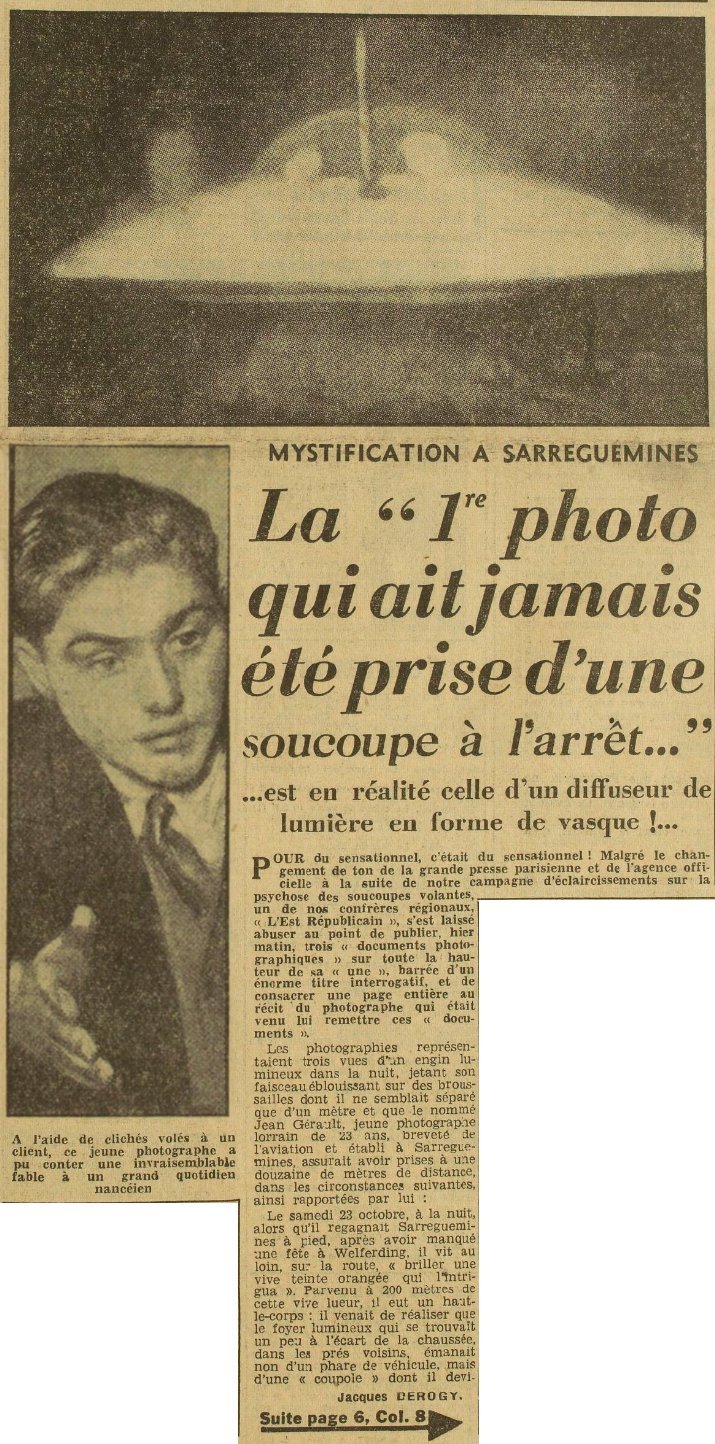
FOR sensationalism, it was sensational indeed! Despite the change in tone of the major Parisian press and the official agency following our campaign to clarify the flying saucer psychosis, one of our regional colleagues, "L'Est Républicain," allowed itself to be deceived to the point of publishing yesterday morning three "photographic documents" across the full height of its front page, topped with a huge questioning headline, and devoting an entire page to the account of the photographer who had brought them these "documents."
The photographs showed three views of a luminous object in the night, casting its dazzling beam onto brush from which it seemed to be separated by only a meter, and which the man named Jean Gérault, a 23-year-old Lorraine photographer, licensed pilot, and based in Sarreguemines, claimed to have taken from about a dozen meters away, under the following circumstances, as he reported:
On Saturday, October 23, at nightfall, while he was walking back to Sarreguemines after missing a celebration in Welferding, he saw in the distance, on the road, "a bright orange glow shining, which intrigued him." When he came within 200 meters of this glow, he started violently: he had just realized that the light source, located slightly off the road in the nearby meadows, did not come from a vehicle headlight, but from a dome whose he was just begin-
Jacques DEROGY
Continued on page 6, col. 8

|
Continued from p. 1, col. 6
was at that moment already clearly outlining its contours and radiating a mass with metallic reflections over which the "dome" dominated.
A faint humming
Seeing no one around, he ventured forward, slipping from tree to tree along the edge of the path. He could see the saucer very clearly. For it was one, of the most classic shape. Heart pounding and short of breath, half crawling in the ditch, he managed to hide behind a trunk, 12 meters from the craft:
It hovered motionless, 1 to 1.5 meters above the grass. It rested on nothing, but emitted a faint humming like that of an electric motor.
"The entire interior of the dome was lit, and in places the rays marked the frosted glass with brighter areas, as if several light sources were projecting their beams from the inside outward. The craft as a whole was perhaps 5 meters in diameter and 2 meters high."
Professional to his fingertips, Jean Gérault had a small camera loaded with 6x9 film in the pocket of his raincoat. He seized it discreetly, focused by guesswork, and braced himself against the tree trunk before taking a one-second exposure:
"Trembling from head to toe, I took two shots like that. Then the camera slipped from my hands. I bent down to pick it up and took two more shots."
The photographer then saw the saucer increase its brightness, rise obliquely, pass very quickly over the nearby bushes, and disappear far ahead into the low clouds. He waited eight days without reacting to recover from his emotions and develop his film in his father's laboratory in Vézelise. Then he took his negatives to a Nancy newspaper where his "testimony" was recorded.
Immediately consulted by the editorial staff of that newspaper, an aviation specialist, Lieutenant-Colonel Leroy, vice-president of the Eastern Aero Club, gave his considered opinion in these terms:
"The documents that have just been presented to me are impressive. Until now I had known of only one serious photographic document: the one taken in the United States several years ago. It was an overall photograph of craft in flight. In view of the American document, one considers the possibility of luminous phenomena due to lenticular formations often encountered in the sky. Whereas the photograph presented here has much more precise and concrete material aspects. One remains perplexed before the photographs just placed before me, whose details can hardly be effects of optical illusion. If this is a fake, the fake itself would already be quite a feat..."
It was indeed a feat - not of skill, but of fakery - by no means intended, moreover, to serve the hoax that young Jean Gérault fabricated entirely. The photographs he had brought to the newspaper were not his work, but that of a student who had given him a roll of film to develop at the shop where he was employed.
This student had photographed a bowl-shaped light diffuser suspended from a ceiling, with the aim of playing a prank on a circle of friends. He had not been able to recover his photos, the photographer claiming that the film had not been exposed and returning a blank roll in exchange.
One can imagine the student's surprise when he saw yesterday morning in the newspaper the proof of a success whose perfection had been fraudulently exploited by the photographer's dishonesty. He immediately filed a complaint, and Jean Gérault finally had to admit both the theft and the deception before the gendarmes of Sarreguemines.
Nevertheless, a major newspaper allowed itself to be far too easily fooled. Although it sprinkled its headlines and lengthy article with timid reservations, it seriously fell into the trap by writing:
"This extraordinary document that we publish as a total exclusive is probably the first photograph ever taken up close, of a flying saucer at rest...
"That is why we do not think we are exaggerating in claiming that the account below and the three photographs of a saucer we present here constitute, especially from a photographic standpoint, the most important documents that have, anywhere in the world, so far been added to the flying saucer file."
But, as we have already written, the "flying saucer" file is not open, because for now it would contain nothing but hot air. It is not by publishing indiscriminately, right and left, all the accounts coming from every town in France that one will manage to detect a new phenomenon - if such a phenomenon exists. Nor is it by submitting to a panel of technicians or "specialists" incomplete "testimonies" and imprecise "observations" devoid of objective meaning that one will scientifically frame the problem - if there is a problem. Unless the aim is to muddy the waters or maintain a psychosis.
As for us, we have long decided to spare our readers this kind of unchecked account, without failing to expose hoaxes whenever possible.
And we are all the better for it.


