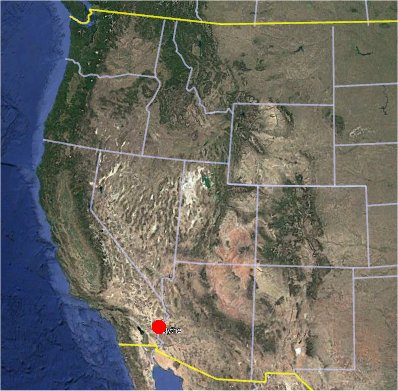
Blythe, California, USA, in the beginning of the Summer of 1947:
ACUFO-1947-07-00-BLYTHE-1
In his 1993 book "Alien Contact - Top Secret UFO Files Revealed", the British author and ufologist Timothy Good told of an aircraft and UFO encounter he heard about from the witness, Bill Lear J., a son of the inventor of the Learjet Bill Lear.
Timothy Good indicates that it happened on a clear night in the early summer of 1947. Young pilot Bill Lear was growing tired as he cruised in his Lockheed P-38 Lightning at 9,000 to 10,000 feet altitude on a flight from Grand Rapids, Michigan, to Los Angeles, California where he was due to participate in the Bendix Trophy Race the following day.
Shortly after passing over the Colorado River near Blythe, California, he experience what he told Timothy Good like this:
"Suddenly, I looked off to my left side and I saw a round fuselage, with round windows in it. And of course, at that time, the only commercial airliner that was flying that had round windows was a DC-4. And instantly, judging from my position in relation to that body, I judged that I was about fifty feet from running into the trailing edge of the wing of that airplane. So, no matter how hopeless it seems, you always try to avoid something."
"I was gaining on it, so I immediately racked the P-38 over into a 90-degree bank to the right and pulled as hard as I could, almost with my eyes closed, expecting to crash into the wing of that airplane. And to my astonishment, nothing happened!"
"I breathed a sigh of relief, and when I figured I was about 90 degrees off the westerly heading, which would have put me north, I rolled out. And as I rolled out, I looked to my left, and it was still there! And this is our over the desert - I'd already passed all the lights behind me - and there it still was, with the little round windows looking for all the world like DC-4 windows. But the light behind the windows was not white; it was a bit yellowish."
"And here I was, in exactly the same position as l had been before, and I thought, This is totally impossible. But the brain won't accept that. When you're about to die, and when you're about to crash into the trailing edge of the wing of another airplane, you don't stop to think how the hell did it get there, you just get out of there! There's no time to think."
"So, I simply executed the same maneuver, rolled to the right again in a 90-degree bank, pulled as hard as I could again, thinking to myself, My God, what is happening? The DC-4 can't follow me! But nonetheless there it was."
"And when I rolled out the second time, heading east, it was gone. But there was no question, if it had been an aircraft, I would - on the first occasion - have plowed into the trailing edge of the wing. The second time, there was no way it could have been an aircraft. In 1947, I had not read anything about any flying saucers or the cigar-shaped things. I was so relieved, that l hadn't run into any airplane. Nothing could have stayed pace with me like that thing did, I couldn't explain it, and I was so tired that I simply made a 180 (-degree turn) and continued on to the west and landed in California."
Timothy Good adds that Bill Lear had done a considerable amount of research into UFOs, as he learned when they discussed the subject in his London home in 1990.
Timothy Good told Bill Lear that the skeptics would say that the sighting was caused by overfatigue and was an hallucination; and he gives Bill Lear's answer as:
"When you're flying along and you see something that you recognize, you suddenly come very much awake. I mean, the adrenaline starts pumping. And I was awake, standing right on my tiptoes in the airplane, practically, because that really gets - your heart started to see something casually, OK, I'll buy hallucination - possible hallucination - because of fatigue. Or you misinterpret lights on the ground for something that might be flying next to you. But when you turn into the black sky at ten or eleven o'clock at night, and there are only stars above you and there are these round windows, that fuselage that you can make out the shape of, and those round windows with very pale yellow lights behind them, and you don't know what the hell it is, except the only thing you recognize is if it's got a fuselage, it must have wings, and you're about to plow into the trailing edge of the wing - you move, and get the hell out of there!"
"OK, the first time, you panic and break right, and if there's nothing, OK, you just saw some lights on the ground and you were tired and perhaps had a mild hallucination. Second time - black sky - still there - no way!"
| Date: | Beginning of the Summer of 1947 |
|---|---|
| Time: | 10 p.m. or 11 p.m. |
| Duration: | ? |
| First known report date: | 1990 |
| Reporting delay: | 4 decades. |
| Country: | USA |
|---|---|
| State/Department: | California |
| City or place: | Over the Colorado River near Blythe. |
| Number of alleged witnesses: | 1 |
|---|---|
| Number of known witnesses: | 1 |
| Number of named witnesses: | 1 |
| Reporting channel: | Told to ufologist Timothy Good. |
|---|---|
| Visibility conditions: | Night. |
| UFO observed: | Yes. |
| UFO arrival observed: | ? |
| UFO departure observed: | No. |
| UFO action: | Follows plane despite evasive actions. |
| Witnesses action: | Observed, evasive action twice. |
| Photographs: | No. |
| Sketch(s) by witness(es): | No. |
| Sketch(es) approved by witness(es): | No. |
| Witness(es) feelings: | Puzzled. |
| Witnesses interpretation: | First DC-4 plane, then not a plane, later UFO. |
| Sensors: |
[X] Visual: 1.
[ ] Airborne radar: N/A. [ ] Directional ground radar: [ ] Height finder ground radar: [ ] Photo: [ ] Film/video: [ ] EM Effects: [ ] Failures: [ ] Damages: |
|---|---|
| Hynek: | CE1 |
| Armed / unarmed: | Unarmed. |
| Reliability 1-3: | 2 |
| Strangeness 1-3: | 3 |
| ACUFO: | Unknown credibility. |
[Ref. tgd1:] TIMOTHY GOOD:
It was a clear night in the early summer of 1947. The young pilot was growing tired as he cruised in his Lockheed P-38 Lightning at nine thousand to ten thousand feet, en route from Grand Rapids Michigan, to Los Angeles, where he was due to participate in the Bendix Trophy Race the following day.
Shortly after passing over the Colorado River near Blythe, California, he was alerted by something so startling that it has left an indelible impression to this day. Bill Lear described the incident to me as follows:
Suddenly, I looked off to my left side and I saw a round fuselage, with round windows in it. And of course, at that time, the only commercial airliner that was flying that had round windows was a DC-4. And instantly, judging from my position in relation to that body, I judged that I was about fifty feet from running into the trailing edge of the wing of that airplane. So, no matter how hopeless it seems, you always try to avoid something.
I was gaining on it, so I immediately racked the P-38 over into a 90-degree bank to the right and pulled as hard as I could, almost with my eyes closed, expecting to crash into the wing of that airplane. And to my astonishment, nothing happened!
I breathed a sigh of relief, and when I figured I was about 90 degrees off the westerly heading, which would have put me north, I rolled out. And as I rolled out, I looked to my left, and it was still there! And this is our over the desert - I'd already passed all the lights behind me - and there it still was, with the little round windows looking for all the world like DC-4 windows. But the light behind the windows was not white; it was a bit yellowish.
And here I was, in exactly the same position as l had been before, and I thought, This is totally impossible. But the brain won't accept that. When you're about to die, and when you're about to crash into the trailing edge of the wing of another airplane, you don't stop to think how the hell did it get there, you just get out of there! There's no time to think.
So, I simply executed the same maneuver, rolled to the right again in a 90-degree bank, pulled as hard as I could again, thinking to myself, My God, what is happening? The DC-4 can't follow me! But nonetheless there it was.
And when I rolled out the second time, heading east, it was gone. But there was no question, if it had been an aircraft, I would - on the first occasion - have plowed into the trailing edge of the wing. The second time, there was no way it could have been an aircraft. In 1947, I had not read anything about any flying saucers or the cigar-shaped things. I was so relieved, that l hadn't run into any airplane. Nothing could have stayed pace with me like that thing did, I couldn't explain it, and I was so tired that I simply made a 180 (-degree turn) and continued on to the west and landed in California.
Bill Lear is a son of the late William P. Lear, designer of the Learjet, and together with his brother John - also a pilot - has done a considerable amount of research into UFOs, as I soon learned when we discussed the subject in his London home in 1990. One aspect of the, 1947 sighting bothered me, however.
"Bill. the skeptic would say that you were just overfatigued and were hallucinating," I remarked, after listening to his account, "When you're flying along and you see something that you recognize, you suddenly come very much awake," he replied, "I mean, the adrenaline starts pumping. And I was awake, standing right on my tiptoes in the airplane, practically, because that really gets - your heart started - to see something casually, OK, I'll buy hallucination - possible hallucination - because of fatigue. Or you misinterpret lights on the ground for something that might be flying next to you. But when you turn into the black sky at ten or eleven o'clock at night, and there are only stars above you and there are these round windows, that fuselage that you can make out the shape of, and those round windows with very pale yellow lights behind them, and you don't know what the hell it is, except the only thing you recognize is if it's got a fuselage, it must have wings, and you're about to plow into the trailing edge of the wing-you move, and get the hell out of there!
"OK, the first time, you panic and break right, and if there's nothing, OK, you just saw some lights on the ground and you were tired and perhaps had a mild hallucination. Second time - black sky - still there - no way!"'
[Ref. lhh1:] LARRY HATCH:
744: 1947/07/00 22:00 3 114:45:00 W 33:37:00 N 3311 NAM USA CLF 7:6
W/BLYTHE,CA:BILL LEAR/P38 PLANE:2 NEAR COLLISION WITH WINGLESS FUSELAGE:
Ref#125 GOOD, Timothy: ALIEN CONTACT. Page No. 22: IN-FLIGHT
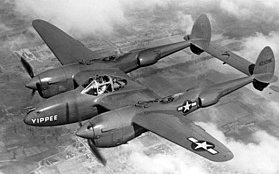
The Lockheed P-38 “Lightning” was an American twin-engine, single-seat fighter plane used at this time of the Second World War, capable of a maximum speed of 666 km/h or even 712 km/h with WEP compressor.
|
It was normally armed with a 20 mm HS-404 cannon, 4 12.7 mm M2 machine guns, and could carry 2 bombs, or a torpedo, or 10 127 mm rockets.
After WWII, many were disarmed and sold for civilian use, especially photogrammetrics.
|
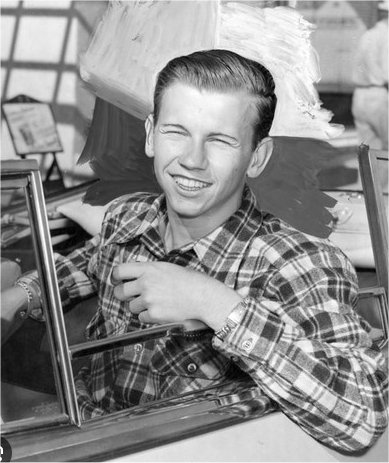
Bill Lear (1928 - 2009), the witness, was a son of William Powell Lear (1902 - 1978), an American inventor and businessman, best known for founding Learjet, the manufacturer of business jets, the car radio, the 8-track cartridge audio tape system, receiving over 140 patents.
William Lear, Jr. was a pilot who began flying at age 15. In 1946 and 1947, he flew in the Bendix Race. In 1948, Lear enlisted in the United States Air Force. After completing training, he was assigned to the 22nd Fighter-Bomber Squadron, 36th Fighter-Bomber Wing at Fürstenfeldbruck AFB. After three years of military service, Lear moved to Geneva, Switzerland in 1956. He became President of Lear S.A. and Director of European Operations for Lear, Incorporated.
Below: Bill Lear Jr, in the cockpit of his P-38, August 19, 1947 photo.
|
Good tells us that Lear was flying to Los Angeles to participate in the Bendix Trophy Race the following day. The race took place between August 30 and September 1, 1947.
Bill Lear did participate in the race; he did fly a P-38; the race did start in Los Angeles. But the date was not the beginning of the Summer, but August 29, 1947.
The Douglas DC-4 is a four-engine transport aircraft built between 1942 and 1947. It did indeed have round windows, numbering 9 on each side.
Another son of William Powell Lear was John Lear (1942 - 2002), claiming he was CIA cargo plane pilot during the Vietnam war. Nicknamed "the Godfather of conspiracy", he spoke of hostile aliens, alien collusion with a secret US government, secret bases, global conspiracies, government cabals, and all sorts of dark secrets. He was a big promoter of the "Majestic 12" hoax, and played a crucial role in bringing Bob Lazar and his sensational and debunked claims into the public eye. John Lear's own claims were totally outlandish; for example he claimed that there are 39 planets in the solar system and we cannot see all of them.
John Lear told that he became interested in UFO matters in the summer of 1986, when a friend retiring from the Air Force stationed at Bentwaters AFB, U-K., told him of an eyewitness account of a UFO landing there around 1980, where three small aliens allegedly exited the craft and approached the Wing Commander, General Gordon Williams.
This, in my opinion, implies that John Lear did not know of the alleged 1947 UFO encounter of his brother Bill Lear; which I find very odd. Even if Bill Lear Jr. did not want to speak out publicly about this sighting, he would likely have told his brother about it, as the latter would certainly have appreciate it.
It think is id a good thing that the British author Timothy Good documented even the wildest "contactees" stories - someone has to do this and not "filter" them out. But I am not at all convinced that this 1947 encounter by Bill Lear really happened.
Of course, I have no proof the story was made up, and no proof it is true, thus I will leave the case as of "unknown credibility".
Unknown credibility.
* = Source is available to me.
? = Source I am told about but could not get so far. Help needed.
| Main author: | Patrick Gross |
|---|---|
| Contributors: | None |
| Reviewers: | None |
| Editor: | Patrick Gross |
| Version: | Create/changed by: | Date: | Description: |
|---|---|---|---|
| 0.1 | Patrick Gross | June 4, 2026 | Creation, [tgd1], [lhh1]. |
| 1.0 | Patrick Gross | June 4, 2026 | First published. |