Between Malingsbo and Krylbo, Sweden, on August 14, 1946:
ACUFO-1946-08-14-MALINGSBO-1
The Intelligence Review of the U.S. Department of Defence, No. 47 of January 9, 1947, declassified in 1977, pubished an article about the "Ghost Rockets" that were widely reported over Scandinavia in 1946. This article was published before the "flying saucers" issue appeared, and before the famous Kenneth Arnold sighting on June 24, 1947.
In the article they told about one of "the few reports available from an individual who should be more reliable and competent then the average", was that of a Swedish Air Force pilot:
On August 14, 1946, at 10:00 a.m., he was flying at 650 feet over central Sweden when he saw a dark, cigar-shaped object about 50 feet long and 3 feet in diameter flying 200 feet above and approximately 6,500 feet away from him at an estimated speed of 400 m. p. h. The missile had no visible wings, rudder, or other projecting part; and there was no indication of any flame or light as has been reported in the majority of other sightings.
His report stated that the missile was maintaining a constant altitude over the ground and, consequently, was following the large features of the terrain. The last statement casts doubt on the reliability of the entire report because of the inability of a wingless missile to maintain a constant altitude over hilly terrain. However, the pilot did imply that there may have been wings which he was unable to see, because he stated that it could not have been a Swedish jet plane as there were none flying in the vicinity at that time.
It was as late as 1995 when Swedish ufologist Güran Jansson published about the case, having obviously read the official report in the Swedish Air forces file.
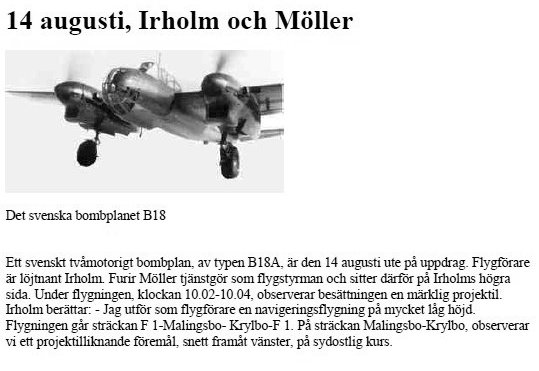
Jansson told that on August 14, 1946, a Swedish twin-engine bomber of the B-18 A type (photo below) was on a mission, with pilot is Lieutenant Irholm and air navigator Corporal Möller seated to the right of Irholm.
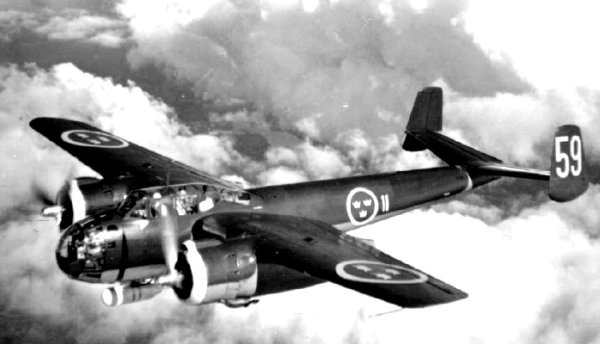
|
During the flight, between 10:02 and 10:04 a.m., the crew observed a strange projectile. Irholm recounted: "As pilot, I am carrying out a navigation flight at very low altitude. The flight follows the route F-1 - Malingsbo - Krylbo - F 1. On the stretch between Malingsbo and Krylbo, we observe a projectile-like object, slightly ahead to the left, on a southeasterly course."
"I estimate that the distance to the object is less than 2,000 meters. We see it just above the wooded horizon line. I estimate that it is flying at approximately 250 meters above the forest. At that moment, our own flight altitude is hardly more than 200 meters. I immediately become suspicious. Recently, we have read a great deal in the newspapers about overflights and intrusions by projectile-like objects. I maintain visual contact with the object at all times so that I can intercept it. After about 10 seconds, the projectile disappears into the clouds. Another 30 seconds later, Corporal Möller spots the object again, this time 30 degrees to our right. I immediately turn onto the object's course and increase to full power - the engines emit a powerful roar. The distance to the object is now less than 1,000 meters. It immediately becomes apparent that I have no possibility of following it. The projectile has a speed of more than 700 km/h, whereas ours is only 380 km/h. After two minutes, the projectile appears again. This time, directly into a storm with dark clouds and heavy rain located to the southeast - I would never fly directly into such a storm!"
The "projectile" resembled the fuselage of a B-18, but had neither (visible) control surfaces nor wings. It was about 15 meters long and 1 meter in diameter. A little later, said Jansson, at 10:15 a.m., after the observation by Irholm and Möller, a witness in Södertälje saw an object with a small spool-shaped body, small wings, and a strut at the rear. It passed eastward at an altitude of 200 meters, emitting a hissing sound reminiscent of a jet aircraft. Janssson explained that this object seen in Södertälje could have been the same as the one observed by Irholm and Möller, as he flight path could match.
The case appeared in several UFO cases catalogues in the 2000's, in summarized manner; then, more detailed information appeared in the ufology bulletin AFU Newsletter, of the Swedish association "Archives for the Unexplained" (AFU), in issue No. 44, September 2002.
In a three-pages article, Swedish ufologist Clas Svahn started by providing the Swedish Air Forces documents on the case, in which the pilot reported:
TO THE AIR DEFENCE DEPT. AT THE DEFENCE STAFF, STOCKHOLM FROM LIEUTENANT I.
Re: A flying missile
I have the honour of reporting an observation while flying on August 14, 1946, at 10.02-10.04 a.m.. I saw a flying missile of the kind that is mentioned in order nr 7:49 of June 12, 1946 from the Defence Staff. The circumstances were as follows.
I was the pilot, on a navigational training flight with a B18 A, at an altitude of l00 m, on the route Fl [Swedish Air Force base at Vasteras] - Malingsbo (18km NW of Skinnskatteberg) - Krylbo - Fl. Sergeant M. was the [back seat) signaler / observer [and wireless controller].
On the route Malingsbo - Krylbo we noticed, after about 2 minutes, an aircraft-shaped object, on the left front, about 60 degrees, on a south-easterly course, slightly over the horizon. I estimated the altitude over terrain of the object to be about 250 m. My own altitude was about 200 m above the ground. The distance to the object was about 2000 m. Weather conditions were as follows:
Cloud altitude at 800 m
Amount of clouds 6-8/10
Horizontal visibility 30-40 kmWith the latest newspaper reports, regarding overflights of Swedish territory by the above-mentioned missiles, on my mind, I immediately got suspicious. Furthermore I could not identify the object as any Swedish aeroplane.
Therefore, I decided to keep eye contact with the object and attempt to overtake it at a suitable opportunity. After about 10 seconds (I had to look down at the instruments to switch over to maximum cruising speed) the object was gone.
I suspected it had disappeared under the horizon, therefore I reduced our own cruising altitude. It appeared that both the object and I had come over a relatively low countryside, and we had both reduced the cruising altitude thus maintaining a constant altitude above the ground.
After about 20 seconds my [back seat] observer sergeant M. discovered the object again, 30 degrees to our right. We had, meanwhile, kept our own course all the time. Immediately, I made a [right] turn ending up on a parallel course with the object, and switched to maximum speed.
The shortest distance between us was about 1000 m. It immediately appeared that I would not be able to keep pace with the object, whose speed I estimated to be at least 600 - 700 km/h. After about 2 minutes the object had vanished in a south-easterly direction. A storm with heavy rain and a cloud height of 100-300 m lay straight ahead of the object's course, and the object disappeared into it.
My observations in summary:
The object kept a constant cruising altitude of 250 m. Thus (on the whole) it followed the topography of the ground.
Speed was considerably higher than the speed of an aeroplane. Estimated speed of the object at least 600 - 700 km/h. Own speed 380 km/h.
Appearance of the object: reminding me of the fuselage of a B18. No wings, rudder or protruding parts visible at observation distance, colour: dark.
Length estimated approximately 15 m, cross-section about 1 m, shaped like a cigar. No light visible. I had noticed, however, lights emitted from a missile passing over Vasteras on August 11 at 8.48 p.m. [this mass sighting has probably been identified as a bolide, reported as it was from hundreds of places all over the south or Sweden and Norway]
Propeller-driven Swedish fighters cannot be expected to keep pace with this kind of missile.
The observation was made at 10:02 - 10:04. Air routes as per enclosed sketch.
A mix-up with fighter Vampire is out of the question, as no such plane was in the area at the time of observation as per information received from F13 [the only Swedish air force wing with Vampire jets in the summer of 1946]
Vasteras August 14, 1946
/signed/ I, lieutenant
The other witness also signed the report, indicating he had "nothing further to add to the above report".
Clas Svahn explained that the Swedish Air Force reacted to this report. they organized a visit to the Air Force Base Fl6 on August 22, 1946, with the two witnesses present. The main purpose of the visit was to compare the report of lieutenant I. with the navigational training flight carried out by a division from Fl6, Uppsala wing of the Swedish Air Forces, on August 14, 1946, to find out if the object that the pilot observed could have been a J-26 fighter, i.e. a North American P-51 Mustang.
The Air Force knews that on the same August 14, 1946, nine P-51's carried out navigation training flights on the route Fl6 - point 156 West of Norberg - Floda church, and back to F16]. A first plane took off at 09.40 a.m. UTC and the others followed at intervals of 5 minutes between each plane. They flew at the minimal cruising altitude of 100 meters, maximum 300 meters, at a speed 420-425 km/h. The estimated flying time of 15 minutes has been kept by all aircraft with the largest divergence being 1 minute. After turning point 156 no plane has essentially been on the west of a line from 156 to the church of Floda. After passing point 156 the course was 165 degrees.
As the Lieutenant made the observation at 10:02 - 10:04 UTC, 7 kms east north east of the Malingsbo church, the observed object having an estimated course of 138 degrees, the Air force determined that the only plane of this F16 flights which, according to the time schedule, could have been at the spot of observation at 10:02 - 10:04, was the one that took off at 09.45 am. But its pilot insisted that he never flew west of a line between point 156 and the Floda church. Instead he chose to fly east of this line due to better checkpoints.
Checking the positions and the directions, the Air Force noted that the object observed by the B-18 crew could> have been a P-51 plane from FL6 with regard to the time of observation, the cruising altitude, the changes in altitude relative to the ground and the estimated length of fuselage.
(A map by the Swedish Air Force and a chronology of the occurrence, both published by AFU, are below in this file and help clarify the discussion).
But, the Air Force noted, it could not have been a P-51, considering the statement that the line of flight the P-51 was about 15 km to the east of the point of observation, the course, the cruising speed, the general appearance of the object, and the fact that none of the P-51 pilots saw a B-18.
The Air Force noted that the pilot stated that he first observed the object about 60 degrees to the left, his own course being 245 degrees, his own speed 380 km/h and at a distance of about 3 km. If it had been a P-51 with a speed of 425 km/h, the B -8 pilot] would have been the first to reach the point of intersection. He lost it out of sight and it was rediscovered 45 degrees to the right in front of him, at a distance of about 2 km. The speed of the object must therefore have been at least 800 km/h.
The Air Force noted that because of the short distance and the excellent visibility, the witnesses maintained that the object they observed could not have been mixed up with a P-51 or any other conventional aeroplane.
The Air Force investigator concluded: "With reference to the above I do not consider it as probable that the object observed was a J 26 [P-51] or any other Swedish aeroplane."
Clas Svahn reported that in April and May 1986, he had several telephone interviews with the pilot "Lieutenant Colonel I." who preffered to remain anonymous, although his name is given in the Military Archives documents. He confirmed the details given in his written report and to Air Force investigator Eric Malmberg in 1946, adding that he was even called to come to Stockholm to make an oral statement before the eyes of Air Director Bertil Westergard.
The pilot told Svahn that the object lacked the usual silhouette of an aeroplane, such as a tail fin, saying "What I saw could have been a disc seen from the side, or a cigar. It was close enough for me to be able to judge whether it was a conventional aircraft or not. The object was torpedo-shaped. It was pointed both at the front and at the stern, like a big and fat cigar. There were no contours or nuances of color. It was dark greyish."
No exhaust or smoke was seen. The sighting duration was about 2-3 minutes. The pilot added: "I can say that it was not a Mustang, if so I would not have made such a fuss about this whole thing."
Svahn explains that this pilot was, at the time of the sighting, the head of a B-18 division at the F1 wing, that in December 1946 he took part in flying a group of new Vampire jets from England to the Fl3 wing in Norrkoping, that he later became the head of the Air Force's experimental station, working on flight tests of new Swedish aircraft and missiles. In 1961 he was promoted Lieutenant Colonel and finally left active duty in 1979.
As noted by Jansson, Clas Svahn too told about the sighting from the ground, 11 minutes after the B-18 crew sighting, in Sodertalje, quoting from a letter in the Military Archives:
To the Defence Staff, Stockholm
Wednesday, August 14, [1946] about 10.15 a.m. an object was observed having a small, spool-shaped body and small wings plus a stay at the back, about as shown in the enclosed sketch. The object passed in a north-easterly direction at an altitude of about 200 meters and emitted a sound reminding me of an aeroplane but more hissing.
Place of observation: the western outskirts of Södertälje.
Signed Lundström
Villagatan 41
Södertälje
This sketch was attached to this report:
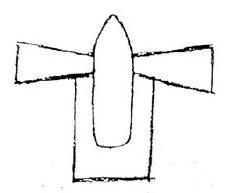
Svahn thought that the Defence staff must have talked to the witness, since there were some additional notes in the Staff's daily summary tables of sightings: "[Speed:] "Not very big. [Trajectory:] "Horizontal", [Description:] "... no propeller, no smoke nor fire" [Comments:] "sighted by two ladies from a garden. Disappeared behind another house."
Clas Svahn attempted to reach the witness, but she and her husband had died in 1982. Clas Svahn managed to trace one of their two daughters, living in Uddevalla, who told him:
"My mother was a true realist and never fantasized. If she has reported such a thing she must have seen such an object. She never made anything up. I have never heard that she should have seen such an object, however. She never told me, and I haven't seen anything about it in her papers."
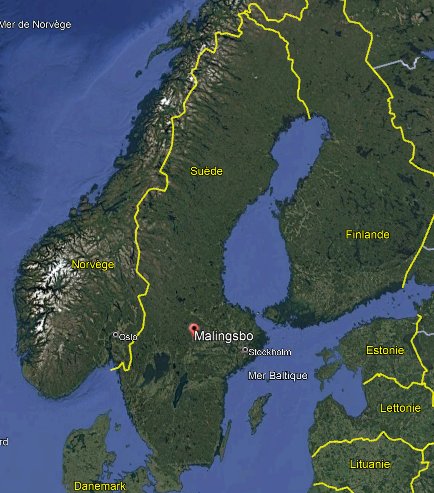
Clas Svahn explained that Södertälje bing situated at Lat. 59° l2' 0 N Long. 17° 37' 0 E, at roughly 150 kilometres in straight line from Malingsbo, and this means an object would have to speed at aboutt 900 km/h to reach there in 10 minutes. Also, Södertälje is right at the extension of the course of the object noted by the two Air Force men.
| Date: | August 14, 1946 |
|---|---|
| Time: | 10:02 a.m. UTC |
| Duration: | 2 to 3 minutes. |
| First known report date: | August 1946 |
| Reporting delay: | Hours. |
| Country: | Sweden |
|---|---|
| State/Department: | Bergslagen |
| City or place: | Between Malingsbo and Krylbo. |
| Number of alleged witnesses: | 3 |
|---|---|
| Number of known witnesses: | 3 |
| Number of named witnesses: | 3 |
| Reporting channel: | Official report. |
|---|---|
| Visibility conditions: | Day, horizontal visibility 30 km. |
| UFO observed: | Yes. |
| UFO arrival observed: | Yes. |
| UFO departure observed: | Yes. |
| UFO action: | Evasive flight. |
| Witnesses action: | Attempt chase, in vain. |
| Photographs: | No. |
| Sketch(s) by witness(es): | No. |
| Sketch(es) approved by witness(es): | No. |
| Witness(es) feelings: | ? |
| Witnesses interpretation: | Not an airplane. |
| Sensors: |
[X] Visual: 2.
[ ] Airborne radar: N/A. [ ] Directional ground radar: [ ] Height finder ground radar: [ ] Photo: [ ] Film/video: [ ] EM Effects: [ ] Failures: [ ] Damages: |
|---|---|
| Hynek: | DD |
| Armed / unarmed: | Armed, machine guns. |
| Reliability 1-3: | 3 |
| Strangeness 1-3: | 3 |
| ACUFO: | Possible extraterrestrial visitors. |
[Ref. int1:] "INTELLIGENCE REVIEW" - US DEFENCE DEPARTMENT:
|
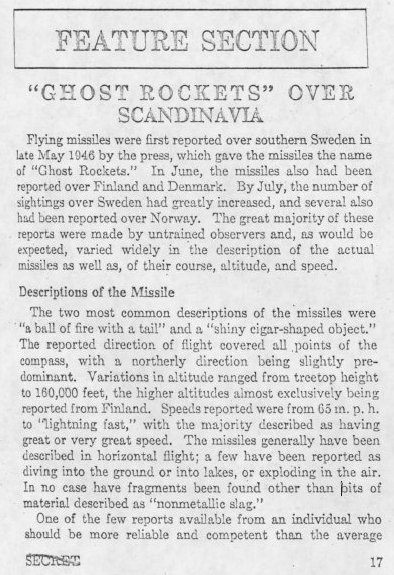
Flying missiles were first reported over southern Sweden in late May 1946 by the press, which gave the missiles the name of "Ghost Rockets." In June, the missiles also had been reported over Finland and Denmark. By July, the number of sightings over Sweden had greatly increased, and several also had been reported over Norway. The great majority of these reports were made by untrained observers and, as would be expected, varied widely in the description oi the actual missiles as well as, of their course, altitude, and speed.
Descriptions of the Missile
The two most common descriptions of the missiles were "a ball of fire with a tail" and a "shiny cigar-shaped object." The reported direction of flight covered all points or the compass, with a northerly direction being slightly predominant. Variations in altitude ranged from treetop height to 10,000 feet, the higher altitudes almost exclusively being reported from Finland. Speeds reported were from 65 in. p. h. to "lightning fast," with the majority described as having great or very great speed. The missiles generally have been described in horizontal flight; a few have been reported as diving into the ground or into lakes, or exploding in the air. In no case have fragments been found other than bits, of material described as "nonmetallic slag."
One of the few reports available from an individual who should be more reliable and competent then the average
17
|
GHOST ROCKETS
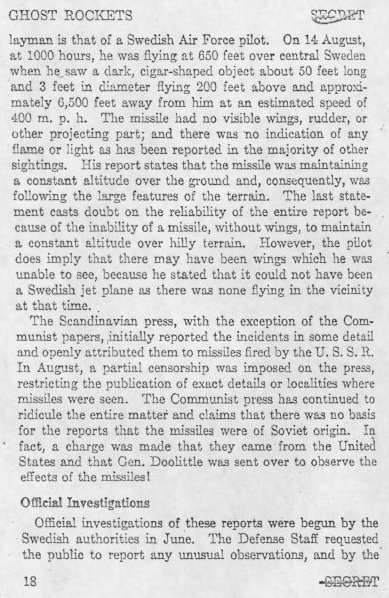
layman is that of a Swedish Air Force pilot. On 14 August, at 1000 hours, he was flying at 650 feet over central Sweden when he saw a dark, cigar-shaped object about 50 feet long and 3 feet in diameter flying 200 feet above and approximately 6,500 feet away from him at an estimated speed of 400 m. p. h. The missile had no visible wings, rudder, or other projecting part; and there was no indication of any flame or light as has been reported in the majority of other sightings. His report states that the missile was maintaining a constant altitude over the ground and, consequently, was following the large features of the terrain. The last statement casts doubt on the reliability of the entire report because of the inability of a. missile, without wings, to maintain a constant altitude over hilly terrain. However, the pilot does imply that there may have been wings which he was unable to see, because he stated that it could not have been a Swedish jet plane as there were none flying in the vicinity at that time.
The Scandinavian press, with the exception of the Com-munist papers, initially reported the incidents in some detail and openly attributed them to missiles fired by the U. S. S. R, In August, a partial censorship was imposed on the press, restricting the publication of exact details or localities where missiles were seen. The Communist, press has continued to ridicule the entire matter and claims that there was no basis for the reports that the missiles were of Soviet origin. In fact, a charge was made that they came from the United States and that Gen. Doolittle was sent over to observe the effects of the missiles!
Official Investigations
Official investigations of these reports were begun by the Swedish authorities in June. The Defense Staff requested the public to report any unusual observations, and by the
18
[Ref. dbr1:] DON BERLINER:
One of the few official American reactions to the "ghost rockets" came in the January 9, 1947 issue of the Defense Department's Intelligence Review (classified "Secret" until 1978). This four-page summary of the "ghost rocket" events suggests that some of the sightings may have been of Soviet test missiles or jet airplanes (although no jets are known to have been in or near Scandinavia at the time). 29
One sighting, detailed in the FBI report cited above, suggests there may have been more to it:
"On 14, August (1946) at 10 a.m. [a Swedish Air Force pilot]... was flying at 650 feet [200 m.] over central Sweden when he saw a dark, cigar-shaped object about 50 feet [15 m.] above and approximately 6,500 feet [2 km.] away from him travelling at an estimated 400 mph [650 km./hr.]. The missile had no visible wings, rudder or other projecting part; and there was no indication of any fuel exhaust (flame or light), as had been reported in the majority of other sightings.
"The missile was maintaining a constant altitude over the ground and, consequently, was following the large features of the terrain. This statement casts doubt on the reliability of the entire report because a missile, without wings, is unable to maintain a constant altitude over hilly terrain." 30
The sources 29 and 30 are described as "Intelligence Review, Number 49, January 9, 1947, 'Ghost Rockets Over Scandinavia.'" [This being [int1] in my file.]
[Ref. gjn1:] G&Ueml;RRAN JANSSON:
|
[Photo caption:] The Swedish B18 bomber
A Swedish twin-engine bomber of the B18A type is on a mission on August 14. The pilot is Lieutenant Irholm. Corporal Möller serves as air navigator and is therefore seated to the right of Irholm. During the flight, between 10:02 and 10:04 a.m., the crew observes a strange projectile. Irholm recounts: "As pilot, I am carrying out a navigation flight at very low altitude. The flight follows the route F 1-Malingsbo-Krylbo-F 1. On the stretch between Malingsbo and Krylbo, we observe a projectile-like object, slightly ahead to the left, on a southeasterly course."
|
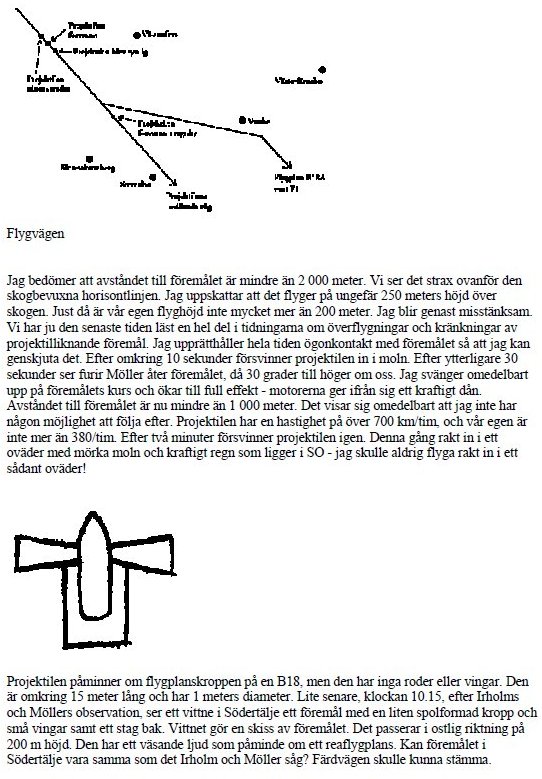
[Map caption:] The flight path
I estimate that the distance to the object is less than 2,000 meters. We see it just above the wooded horizon line. I estimate that it is flying at approximately 250 meters above the forest. At that moment, our own flight altitude is hardly more than 200 meters. I immediately become suspicious. Recently, we have read a great deal in the newspapers about overflights and intrusions by projectile-like objects. I maintain visual contact with the object at all times so that I can intercept it. After about 10 seconds, the projectile disappears into the clouds. Another 30 seconds later, Corporal Möller spots the object again, this time 30 degrees to our right. I immediately turn onto the object's course and increase to full power - the engines emit a powerful roar. The distance to the object is now less than 1,000 meters. It immediately becomes apparent that I have no possibility of following it. The projectile has a speed of more than 700 km/h, whereas ours is only 380 km/h. After two minutes, the projectile disappears again. This time, directly into a storm with dark clouds and heavy rain located to the southeast - I would never fly directly into such a storm!
The projectile resembles the fuselage of a B18, but it has neither control surfaces nor wings. It is about 15 meters long and 1 meter in diameter. A little later, at 10:15 a.m., after the observation by Irholm and Möller, a witness in Södertälje sees an object with a small spool-shaped body, small wings, and a strut at the rear. The witness makes a sketch of the object. It passes eastward at an altitude of 200 meters. It emits a hissing sound reminiscent of a jet aircraft. Could the object seen in Södertälje be the same as the one observed by Irholm and Möller? The flight path could match.
[Ref. dwn1:] DOMINIQUE WEINSTEIN:
French ufologist Dominique Weinstein compiled a catalog of the cases of UFOs observed from aircraft. This case appears in the catalog as:

|
| DATE | 46.08.14 |
|---|---|
| TIME | day |
| COUNTRY | Sweden |
| PLACE | Vasteras |
| M | |
| TYPE OF PLANE AND WITNESSES | a Swedish Air Force B-18 bomber pilot + ground observers |
| DESCRIPTION OVNI | a "ghost rocket" passed right in fron of the plane |
| Radar | |
| G | G |
| X | |
| E | |
| SOURCES | 391 |
The source "391" is referenced at the end of the catalog as:
UFOs 1947-1987, The 40 years search for an explanation, J. Spencer et Hilary Evans (1987)
[Ref. gvo1:] GODELIEVE VAN OVERMEIRE:
|
1946, August 14
SWEDEN, Vaggeryd (Vasteras)
A Swedish military aircraft collided with one of the mysterious projectiles and the three crewmen were killed. A witness claimed that the "projectile" made changes of direction. (Antonio RIBERA: "Procès aux Ovni" - De Vecchi 1977 - p. 36) (vog note: Ribera is the only one to mention this; there is no trace of it in the Swedish archives...) (vog note: no aircraft crash or loss on that date and at that location in the database
http://www.planecrashinfo.com/database.htm Copyright ©1997-2004
Richard Kebabjian)
OTHER VERSION: The pilot of a Swedish B 18 bomber, as well as witnesses on the ground, saw a rocket pass right in front of the aircraft. (PROJECT ACUFOE, Catalogue 1999, Dominique Weinstein)
[Ref. afu1:] ASSOCIATION "ARCHIVES FOR THE UNEXPLAINED":
|
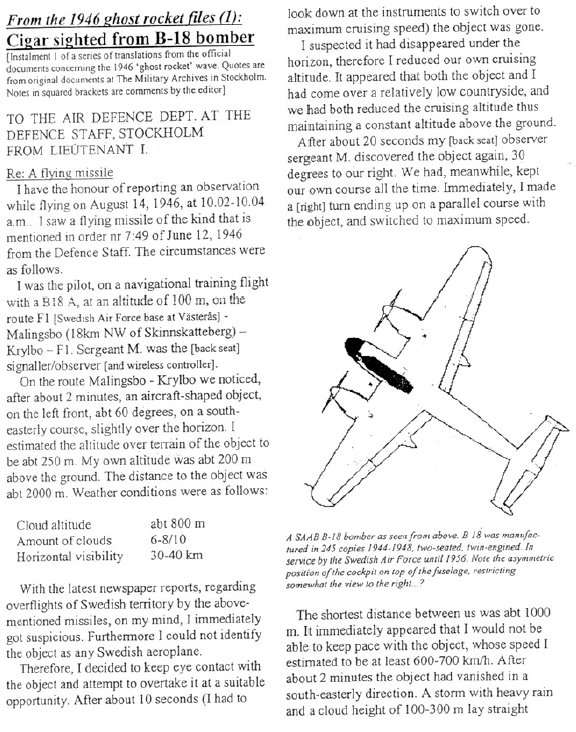
From the 1946 ghost rocket files (1):
[Instalment 1 of a series of translations from the officiel documents concerning the 1946 'ghost rocket' wave. Quotes are from original documents at The Military Archive in Stockholm. Notes in square brackets (here in parenthesis) are comments by the editors]:
TO THE AIR DEFENCE DEPT. AT THE DEFENCE STAFF, STOCKHOLM FROM LIEUTENANT I.
Re: A flying missile
I have the honour of reporting an observation while flying on August 14, 1946, at 10.02-10.04 a.m.. I saw a flying missile of the kind that is mentioned in order nr 7:49 of June 12, 1946 from the Defence Staff. The circumstances were as follows.
I was the pilot, on a navigational training flight with a B18 A, at an altitude of l00 m, on the route Fl [Swedish Air Force base at Vasteras] - Malingsbo (18km NW of Skinnskatteberg) - Krylbo - Fl. Sergeant M. was the [back seat) signaler / observer [and wireless controller].
On the route Malingsbo - Krylbo we noticed, after about 2 minutes, an aircraft-shaped object, on the left front, abt 60 degrees, on a south-easterly course, slightly over the horizon. I estimated the altitude over terrain of the object to be abt 250 m. My own altitude was abt 200 m above the ground. The distance to the object was abt 2000 m. Weather conditions were as follows:
Cloud altitude at 800 m
Amount of clouds 6-8/10
Horizontal visibility 30-40 km
With the latest newspaper reports, regarding overflights of Swedish territory by the above-mentioned missiles, on my mind, I immediately got suspicious. Furthermore I could not identify the object as any Swedish aeroplane.
Therefore, I decided to keep eye contact with the object and attempt to overtake it at a suitable opportunity. After about 10 seconds (I had to look down at the instruments to switch over to maximum cruising speed) the object was gone.
I suspected it had disappeared under the horizon, therefore I reduced our own cruising altitude. It appeared that both the object and I had come over a relatively low countryside, and we had both reduced the cruising altitude thus maintaining a constant altitude above the ground.
After about 20 seconds my [back seat] observer sergeant M. discovered the object again, 30 degrees to our right. We had, meanwhile, kept our own course all the time. Immediately, I made a [right] turn ending up on a parallel course with the object, and switched to maximum speed.
[Sketch caption:] A SAAB B-18 bomber as seen from above. B 18 was manufactured in 245 copies 1944-1948., two-seated, twin-egined. In service by the Swedish Air Force until 1956. Note the asymetrick position of the cockpit on top of fuselage, restricting somewhat the view to the right ...?
The shortest distance between us was abt 1000 m. It immediately appeared that I would not be able to keep pace with the object, whose speed I estimated to be at least 600 - 700 km/h. After about 2 minutes the object had vanished in a south-easterly direction. A storm with heavy rain and a cloud height of 100-300 m lay straight
|
ahead of the object's course, and the object disappeared into it.
My observations in summary:
The object kept a constant cruising altitude of 250 m. Thus (on the whole) it followed the topography of the ground.
Speed was considerably higher than the speed of an aeroplane. Estimated speed of the object at least 600 - 700 km/h. Own speed 380 km/h.
Appearance of the object: reminding me of the fuselage of a B18. No wings, rudder or protruding parts visible at observation distance, colour: dark.
Length estimated approximately 15 m, cross-section abt 1 m, shaped like a cigar. No light visible. I had noticed, however, lights emitted from a missile passing over Vasteras on August 11 at 8.48 p.m. [this mass sighting has probably been identified as a bolide, reported as it was from hundreds of places all over the south or Sweden and Norway]
Propeller-driven Swedish fighters cannot be expected to keep pace with this kind of missile.
The observation was made at 10.02 - 10.04. Air routes as per enclosed sketch.
A mix-up with fighter Vampire is out of the question, as no such plane was in the area at the time of observation as per information received from F13 [the only Swedish air force wing with Vampire jets in the summer of 1946]
Vasteras August 14, 1946
/signed/ I, lieutenant
Staff sergeant M. had nothing further to add to the above report.
Vasteras August 14, l946
/signed/ M., sergeant
REPORT FROM A VISIT TO Fl6 ON AUG 22, 1946
The purpose of the visit was
a) to compare the report of lieutenant I. dated Aug 14 with the navigational training flight carried out by a division from Fl6 [Uppsala wing of the Swedish air force] on Aug 14, to find out if the object that I. [the pilot] observed could have been a J 26 fighter [Swedish designation for North American P-51 Mustang].
b) to keep the aircrew of Fl6, who will be included in the "alert squad", informed. [Note: The Air Force was planning to have a file of planes (two planes) on a constant alert, ready to take off after a ghost rocket].
a) Present at meeting: 7 pilots from Fl6 (2 people were away on assignment), lieutenant I. and sergeant M., F1.
On Aug 14, nine aeroplanes from Fl6 carried out navigation training flights on the [triangular] route Fl6 - point 156 W of Norberg - Floda church (Södermanland) [and back to F16]. Start of first plane at 09.40 a.m. (radio time) with intervals of 5 min [between each plane]. Cruising altitude min 100 m, max 300 m. Cruising speed 420-425 km/h. The estimated flying time of 15 minutes has been kept by all aircraft with the largest divergence being 1 minute. After turning point 156 no plane has essentially been on the west of a line from 156 to the church of Floda.
After passing point 156 the course was 165 degrees.
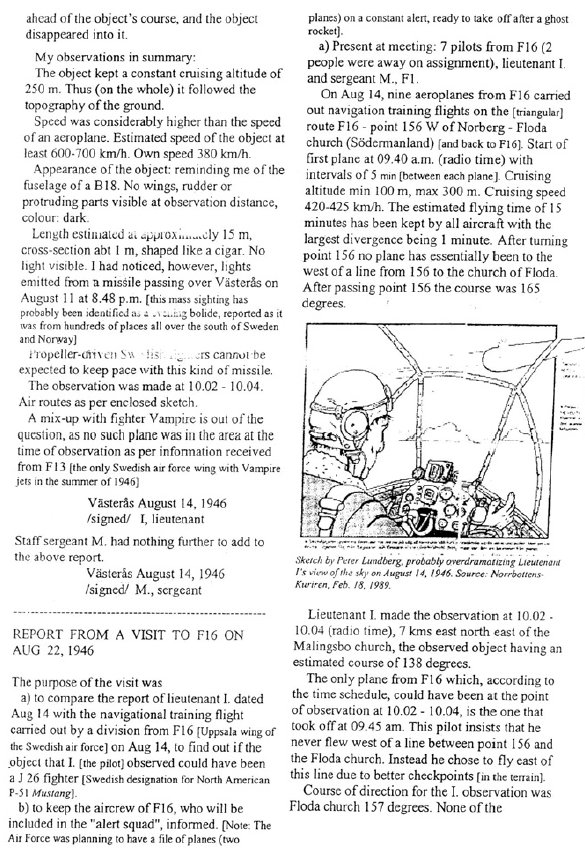
[Sketch caption:] Sketch by Peter Landberg, probably overdramatizing Lieutenant I's view of the sky on August 14, 1946. Source: Norrbottens-Kuriren, Feb. 18. 1989.
Lieutenant I. made the observation at 10.02 - 10.04 (radio time), 7 kms east north east of the Malingsbo church, the observed object having an estimated course of 138 degrees.
The only plane from F 16 which, according to the time schedule, could have been at the point of observation at l0.02 - l 0.04, is the one that took off at 09.45 am. This pilot insists that he never flew west of a line between point 156 and the Floda church. Instead he chose to fly east of this line due to better checkpoints [in the terrain].
Course of direction for the I. observation was Floda church 157 degrees. None of the
|
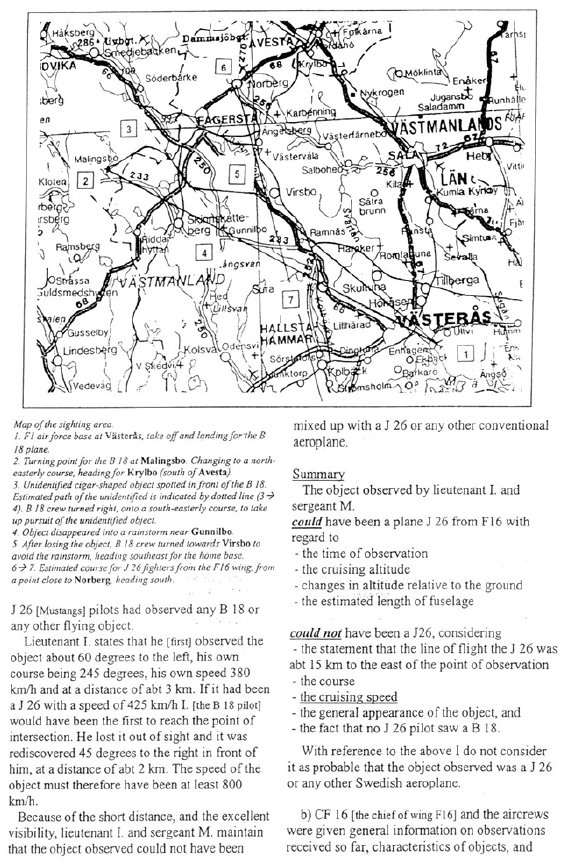
Map of the sighting area
1. F1 air force base at Vasteras, take off and landing for the B 18 plane.
2. Turning point for B 18 at Malingsbo. Changing to a north-easterly course, heading for Krylbo (south of Avesta).
3. Unidentified cigar-shaped object spotted in front of the B 18. Estimated path of the unidentified is indicated by dotted line (3 -> 4). 4) B 18 crew turned right, onto a south-westerly course, to take up pursuit of the unidentified object.
4. Object disappeared into a rainstorm near Gunnilbo.
5. After losing the object, B 18 crew turned towards Virsbo to avoid the rainstorm, heading southeast for the home base.
6 -> 7. Estimated course for J 26 fighters from the F16 wing, from a point close to Norberg, heading south.
J 26 [Mustangs] pilots had observed any B 18 or any other flying object.
Lieutenant I. states that he [first] observed the object about 60 degrees to the left, his own course being 245 degrees, his own speed 380 km/h and at a distance of abt 3 km. If it had been a J 26 with a speed of 425 km/h I. [the B 18 pilot] would have been the first to reach the point of intersection. He lost it out of sight and it was rediscovered 45 degrees to the right in front of him, at a distance of abt 2 km. The speed of the object must therefore have been at least 800 km/h.
Because of the short distance, and the excellent visibility, lieutenant I. and sergeant M. maintain that the object observed could not have been mixed up with a J 26 or any other conventional aeroplane.
Summary
The object observed by lieutenant L and sergeant M. could have been a plane J 26 from FL 6 with regard to
- the time of observation
- the cruising altitude
- changes in altitude relative to the ground
- the estimated length of fuselage
could not have been a 126, considering
- the statement that the line of flight the J 26 was abt 15 km to the east of the point of observation
- the course
- the cruising speed
- the general appearance of the object, and
- the fact that no J 26 pilot saw a B 18
With reference to the above I do not consider it as probable that the object observed was a J 26 or any other Swedish aeroplane.
b) CF 16 [the chief of wing F16] and the aircrews were given general information on observations received so far, characteristics of objects, and
|
specific details that are most important to look for.
Stockholm August 23, 1946
/signed/ Eric Malmberg
Fli [acronym for air engineer]
Interwiev with I. in 1986
In April and May 1986 Clas Svahn had several telephone interviews with Lieutenant Colonel I. I. prefers to remain anonymous, although his name is given in the Military Archives documents. He confirmed the details given in his written report and to Air Force investigator Eric Malmberg in 1946. I. was even called to come to Stockholm to make an oral statement before the eyes of Air Director Bertil Westergard.
I. stated that the object lacked the usual silhouette of an aeroplane, such as a tail fin. "What I saw could have been a disc seen from the side, or a cigar. It was close enough for me to be able to judge whether it was a conventional aircraft or not. The object was torpedo-shaped. It was pointed both at the front and at the stern, like a big and fat cigar. There were no contours or nuances of colour. It was dark greyish."
No exhaust or smoke was seen. The sighting duration was about 2-3 minutes. "I can say that it was not a Mustang, if so I would not have made such a fuss about this whole thing."
Malingsbo has the co-ordinates Latitude 59° 55' 60N, Longitude 15° 25' 60E.
Biographical notes on I.:
Lieutenant I was, at the time of the sighting, the head of a B 18 division at the F1 wing, In December 1946 he took part in flying a group of new Vampire jets from England to the Fl3 wing in Norrkoping, He later became the head of the Air Force's experimental station, working on flight tests of new Swedish aircraft and missiles. In 1961 he was promoted Lieutenant Colonel and finally left active duty in 1979.
Eleven minutes later in Sodertalje
[Quoted from a letter in the Military Archives]
To the Defence Staff, Stockholm
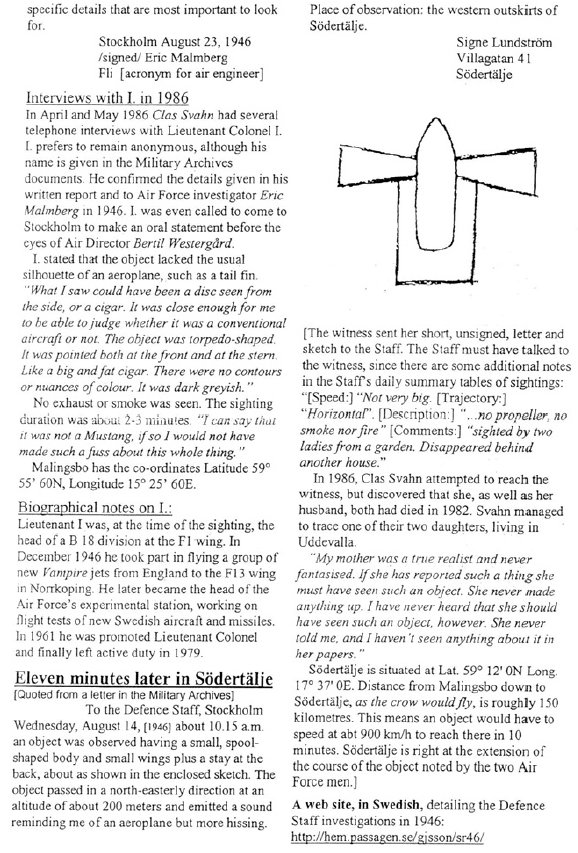
Wednesday, August 14, [1946] about 10.15 a.m. an object was observed having a small, spool-shaped body and small wings plus a stay at the back, about as shown in the enclosed sketch. The object passed in a north-easterly direction at an altitude of about 200 meters and emitted a sound reminding me of an aeroplane but more hissing.
Place of observation: the western outskirts of Södertälje.
Signe Lundström
Villagatan 41
Södertälje
[Sketch.]
[The witness sent her short, unsigned, letter and sketch to the Staff. The Staff must have talked to the witness, since there are some additional notes in the Staff's daily summary tables of sightings: "[Speed:] "Not very big. [Trajectory:] "Horizontal", [Description:] "... no propeller, no smoke nor fire" [Comments:] "sighted by two ladies from a garden. Disappeared behind another house."
In 1986, Clas Svahn attempted to reach the witness, but discovered that she, as well as her husband, both had died in 1982. Svahn managed to trace one of their two daughters, living in Uddevalla.
"My mother was a true realist and never fantasised. If she has reported such a thing she must have seen such an object. She never made anything up. I have never heard that she should have seen such an object, however. She never told me, and I haven't seen anything about it in her papers."
Södertälje is situated at Lat. 59° l2' 0N Long. 17° 37' 0E. Distance from Malingsbo down to Södertälje, as the crow would fly, is roughly 150 kilometres. This means an object would have to speed at abt 900 km/h to reach there in 10 minutes. Södertälje is right at the extension of the course of the object noted by the two Air Force men.]
A web site, in Swedish, detailing the Defence Staff investigations in 1946:
http://hem.passagen.se/gisson/sr46/
Note: hem.passagen.se/gisson/sr46 does not exist anymore.
[Ref. dbr2:] DON BERLINER:
This ufologist indicates that a sighting in Sweden is detailed in the FBI report of August 19, 1947, on the "flying discs":
"On August 14 (1946) at 10:00 a.m., (a Swedish Air Force pilot) (...) was flying at 650 feet (200 m) over central Sweden when he observed a dark cigar-shaped object about 50 feet (15 m) higher and at an approximate distance of 6,500 feet (2,000 m), moving at an estimated speed of 400 mph [650 km/h]. The missile had no visible wings, tail assembly, or other projecting parts; nor did it leave behind any exhaust trace (flames or light), as had been reported in most of the other observations."
"The missile maintained a constant altitude above the ground and therefore followed the terrain contours. This statement casts doubt upon the reliability of the entire report, because a missile, lacking wings, is incapable of maintaining a constant altitude relative to hilly terrain."
Don Berliner indicates that the source is "Ghost Rockets over Scandinavia", in Intelligence Review No. 49, January 9, 1947.
[Ref. snu1:] WEBSITE "SATURDAY NIGHT UFORIA":
But there are other [1946 "ghost rocket" reports in Sweden and Norway] reports which are decidedly un-meteorish. From an official Swedish military report dated August 14, 1946.
TO THE AIR DEFENCE DEPT. AT THE DEFENCE STAFF, STOCKHOLM
FROM LIEUTENANT [NAME DELETED]
Re: A flying missile
I have the honour of reporting an observation while flying on August 14, 1946, at 10.02-10.04 a.m.. I saw a flying missile of the kind that is mentioned in order nr 7:49 of June 12, 1946 from the Defence Staff. The circumstances were as follows.
I was the pilot, on a navigational training flight with a B18 A, at an altitude of 100 m, on the route F1 - Krylbo - F1. Sergeant [NAME DELETED] was the signaller/observer.
On the route Malingsbo - Krylbo we noticed, after about 2 minutes, an aircraft-shaped object, on the left front, abt 60 degrees, on a south-easterly course, slightly over the horizon. I estimated the altitude over terrain of the object to be abt 250 m. My own altitude was abt 200 m above the ground. The distance to the object was abt 2000 m. Weather conditions were as follows:
Cloud altitude abt 800 m
Amount of clouds 6-8/10
Horizontal visibility 30-40 km
With the latest newspaper reports, regarding overflights of Swedish territory by the above-mentioned missiles on my mind, I immediately got suspicious. Furthermore I could not identify the object as any Swedish aeroplane.
Therefore, I decided to keep eye contact with the object and attempt to overtake it at a suitable opportunity. After about 10 seconds (I had to look down at the instruments to switch over to maximum cruising speed) the object was gone.
I suspected it had disappeared under the horizon, therefore I reduced our own cruising altitude. It appeared that both the object and I had come over a relatively low countryside, and we had both reduced the cruising altitude thus maintaining a constant altitude above the ground.
After about 20 seconds my observer sergeant [NAME DELETED] discovered the object again, 30 degrees to our right. We had, meanwhile, kept our own course all the time. Immediately, I made a turn ending up on a parallel course with the object, and switched to maximum speed.
The shortest distance between us was abt 1000 m. It immediately appeared that I would not be able to keep pace with the object, whose speed I estimated to be at least 600-700 km/h. After about 2 minutes the object had vanished in a south-easterly direction. A storm with heavy rain and a cloud height of 100-300 m lay straight ahead of the object's course, and the object disappeared into it.
My observations in summary:
The object kept a constant cruising altitude of 250 m. Thus (on the whole) it followed the topography of the ground.
Speed was considerably higher than the speed of an aeroplane. Estimated speed of the object at least 600-700 km/h. Own speed 380 km/h.
Appearance of the object: reminding me of the fuselage of a B18. No wings, rudder or protruding parts visible at observation distance, colour: dark.
Length estimated at approximately 15 m, cross-section abt 1 m, shaped like a cigar. No light visible. I had noticed, however, lights emitted from a missile passing over Vasteras on August 11 at 8.48 p.m.
Propeller-driven Swedish fighters cannot be expected to keep pace with this kind of missile.
The observation was made at 10.02 - 10.04. Air routes as per enclosed sketch.
A mix-up with fighter Vampire is out of the question, as no such plane was in the area at the time of observation as per information received from F13.
Vasteras August 14, 1946
/signed/ [NAME DELETED], lieutenant
Staff sergeant [NAME DELETED]. had nothing further to add to the above report.
Vasteras August 14, 1946
/signed/ [NAME DELETED], sergeant
[Ref. mss1:] MICHAEL D. SWORDS:
On August 14 [1946] Swedish Air Force pilot Lieutenant Gunnar lrholm and his signaler, Corporal Möller, were flying on a training mission between Malingsbe and Krylbo in Dalecarlia. The Lime was a couple or minutes after ten o'clock in the morning and the visibility was good with a rainstorm coming in from the southeast. The two men were flying a B 18A bomber at 650 feet over a forest area 4.3 miles east-northeast of Malingsbo church when Gunnar lrholm suddenly saw an unknown aircraft corning from his left on a southeasterly course in front of their airplane. "Just over the horizon I could see an elongated object without the typical features of an aircraft. It had no tail fin, for example. What we saw was the picture of a cigar. a torpedo. We were close enough to be sure that this was not an aircraft," Gunnar lrholm remembered when interviewed in 1986.14 His report was filed just minutes after landing in Vasteras. There Gunnar Irholm wrote that after spotting the object they lost eye contact for a short period of time, but after adjusting their height it reappeared 20 seconds later. "I immediately put my aircraft on a parallel course and put on full power. The shortest distance we had to the craft was just over 3,000 feet lone kilometer I but I soon realized that we were not able to catch up with the craft whose speed I estimate to between 370 and 430 miles per hour. Two minutes later it had vanished to the South East," lrholm wrote in the official report.' The unknown object vanished into the storm cloud.
A full investigation was made and Lieutenant Irholm and Corporal Moller were both summoned to a meeting with one of the prime investigators from the Ghost Rocket committee, Eric Malmberg, eight days later. Eric Malmberg's conclusion was that the object had not been a Swedish aircraft. But what was it? "He must have seen something. l later got to know Gunnar lrholm very well and he was always a very balanced person," said Eric Malmberg later in an interview. 16 And Gunnar lrholm was a pilot with great experience. At the time of the observation he was in charge of a division of B 18s and would later the same year fly to Britain in charge of bringing four J28 Vampires back to Sweden. He was later appointed to head the military testing grounds at Malmslart where new aircraft, missiles and rockets were tested before being used.
To Gunnar Irholm the incident over Dalecarlia was a mystery for all of his life. ln one of his telephone conversations with Clas Svahn, he said that no one ever made fun of him or failed to take him seriously when he told them about the strange craft. What it was he never knew: "As I sensed il the object never bothered about us but just kept flying on its course. It was a grey cigar, pointed in both ends, around 50 feet 115 meters] long and just over 3 feet (one meter) in diameter, l had hoped that they should have registered something on radar but I never got any information that it was seen."
Even though Gunnar Irholm's encounter was to be the only contact with a Ghost Rocket made by a Swedish pilot during 1946, there were several other incidents that puzzled the Ghost Rocket committee. During four days in July, the Defense Staff received around 300 reports and when the summer was over, 997 reports had been registered by the Staff. The real number of observations probably far exceeded that.
The sources are detailed as interviews with Gunnar Irholm by clas Svahn on April 25 and May 20, 1986, and "Löjtnant G. Irholm med rapport om flygande projektil to Försvarstabens Luftförsvarsavdelnig, 14 August 1946."
[Ref. tgd1:] TIM GOOD:
Two days later, on 14 August, the two-man crew of a BIS reported a close encounter with one of the missiles. The following is translated from the first part of an official report to the Air Defence Department, Stockholm, by Lieutenant I:
I was the pilot, on a navigational training flight with a B18A, at an altitude of 100 m, on the route Pl (Swedish Air Force base at Vateras] - Malingsbo ( 18 km NW of Skinnskatteberg) - Krylbo - PL Sergeant M was the (back-seat] signaller/observer (and wireless operator).
On the route Malingsbo-Krylbo we noticed, after about 2 minutes, an aircraft-shaped object, on the left front, about 60 degrees, on a south-easterly course, slightly above the horizon. I estimated the altitude over terrain of the object to be about 250 m. My own altitude was about 200 m above the ground. The distance to the object was about 2000 m. Weather conditions were as follows: cloud altitude, about 800 m; amount of clouds, 6-8/10; horizontal visibility, 30-40 km.
With the latest newspaper reports, regarding overflights of Swedish territory by the above-mentioned missiles, on my mind, 1 immediately became suspicious. Furthermore I could not identify the object as any Swedish aeroplane. Therefore, I decided to keep eye contact with the object and attempt to overtake it at a suitable opportunity. After about 10 seconds (l had to look down at the instruments to switch over to maximum cruising speed) the object was gone. I suspected it had disappeared under the horizon, therefore I reduced our own cruising altitude. It appeared that both the object and I had come over a relatively low countryside, and we had both reduced the cruising altitude thus maintaining a constant altitude above the ground.
After about 20 seconds my (back-seat) observer Sergeant M. discovered the object again, 30 degrees 10 our right. We had, mean-while, kepi our own course all the time. Immediately, I made a (right] tum ending up on a parallel course with the object, and switched to maximum speed.
The shortest distance between us was about 1000 m. It immediately appeared that I would not be able to keep pace with the object, whose speed I estimated to be at least 600-700 km/h. After about 2 minutes the object had vanished in a south-easterly direction. A storm with heavy rain and a cloud height of 100-300 m lay straight ahead of the object's course, and the object disappeared into it.
The object kept a constant cruising altitude of 250 m. Thus (on the whole) it followed the topography of the ground. Speed was con-siderably higher than the speed of a plane ... at least 600-700 km/h. Our own speed [ at the time I 380 km/h. Appearance of the object: reminding me of the fuselage of a BIS. No wings, (tail-fin] or protruding parts visible at observation distance. Colour, dark. The observation was made at 10:02 ...
No smoke or exhaust was observed. At the time of the sighting, Lieutenant I. was the head of a BIS division at the Fl wing. He later became head of the Air force's experimental station, working on flight tests of new Swedish aircraft and missiles. In telephone interviews in 1986 with leading researcher Clas Svahn, the pilot confirmed the accuracy of his report and added that he had been summoned to Stockholm by the Air Director to give an oral statement.
"What I saw could have been a disc seen from the side, or a cigar," the pilot explained to SVilho. "It was close enough for me to be able to judge wether it was a conventional aircraft or not. The object was torpedo-shaped. It was pointed both at the front end and at the stern - like a big and fat cigar (see plate section). There were no contours or nuances of colour. It was dark grayish.'"
[Ref. nip1:] "THE NICAP WEBSITE":
Aug. 14, 1946; Bt. Malingsbo and Krylbo, Sweden
10:02 a.m. Two witnesses flying a SAAB B-18 bomber on a navigational training flight at 200 meter altitude observed a cigar-shaped object described as 1 meter wide by 15 meters long. (Credit: John Schuessler; AFU Newsletter, Issue 44, Sept. 2002)
The summary has a link to: https://www.nicap.org/460814malingsbo.pdf [afu1]
[Ref. get1:] GEORGE M. EBERHART:
August 14 - 10:02 a.m. Swedish Air Force pilot Lieut. Gunnar Irholm and his signaler, Cpl. Möller, are flying a B-18A bomber at 650 feet 4 miles northeast of Malingsbo in central Sweden when they see a dark cigar-shaped object approaching on their left. It has no visible wings, rudders, lights, flame or projections of any type. It appears to follow the terrain at 370-430 mph, maintaining the same height, then vanishes into a storm cloud. ("Ghost Rockets over Scandinavia," Intelligence Review, no. 49, January 9, 1947, US Department of Defense; Don Berliner, Marie Galbraith, and Antonio Huneeus, Unidentified Flying Objects Briefing Document, UFO Research Coalition, December 1995, pp. 33-35; Swords 15-16; "Cigar Sighted from B-19 Bomber," AFU Newsletter, no. 44 (September 2002): 1-4)
[Ref. jmd1:] JOEL MESNARD:
The first attempt to intercept a UFO may have been the one that took place on the morning of August 14, 1946, during the "ghost rocket" wave over Sweden 125. Shortly after 10 a.m., the crew of a twin-engine Saab B 18A from the F1 squadron of the Flygvapnet had just taken off from the Västerås base for a low-altitude navigation training flight. The planned route was the triangle Västerås - Malingsbo - Krylbo - Västerås. On board were two men: Lieutenant I, the pilot, and Sergeant M, the radio observer (positioned behind the pilot, but facing away from him).
In the report he wrote, the pilot explained that two minutes after turning at Malingsbo, he was heading toward Krylbo and flying between 100 and 200 meters altitude when an object appeared on his left, to the north, fairly low on the horizon. The object was moving toward the south-southeast on a trajectory that would cross that of the aircraft, though at a slightly higher altitude. Initially, it may have been about 2 km away from the twin-engine aircraft. The cloud ceiling was around 800 meters and covered six to eight tenths of the sky. Horizontal visibility was 30 to 40 km. Lieutenant I was aware of the appearances that had been occurring in the skies of his country for several weeks. In fact, he himself had been one of the many witnesses to the passage of an unidentified object over Västerås three days earlier, on August 11 at 8:48 p.m. He therefore observed the thing carefully, as it did not resemble any type of aircraft then in service in Sweden. Having lowered his head to look at his instruments, the pilot lost sight of the object for a moment, but the radio observer spotted it again a few seconds later, 30° to the right. Leaving the planned route, the pilot turned right to adopt a trajectory parallel to that of the UFO and opened the throttle fully. But the B 18 was not a fighter aircraft. Its modest engines (those of a DC-3) were not going to allow it to exceed 380 km/h before the end of the sighting. As for the estimated distance between the object and its pursuer, it was never less than 1,000 meters. The thing, dark in color, had the appearance of a cigar, without wings or tail surfaces, and without visible protrusions. It may have been about fifteen meters long with a diameter on the order of 1 m. It appeared to be flying between 600 and 700 km/h. There was therefore no hope of catching it. After two minutes of pursuit, it disappeared toward the southeast into a storm cloud. Despite the description provided by the crew, the military hierarchy attempted to find a mundane explanation for the incident. For several weeks, De Havilland Vampire F1s had entered service within the F-16 wing based at Uppsala. The two witnesses were therefore suspected of having failed to identify a Vampire. Consequently, a meeting was organized on August 22 in Uppsala between them and seven F16 pilots. Simple considerations of date and time were enough to eliminate the hypothesis: it could not have been a Vampire.
Joël Mesnard indicated that the source is No. 44 of September 2002 of the Swedish bulletin AFU Newsletler.
[Ref. csn1:] CLAS SVAHN:
Swedish military personnel also observed ghost rockets, notably Air Force pilot Lieutenant Gunnar Irholm who, on August 14, chased a ghost rocket over Dalecarlia. Gunnar Irholm was then stationed at the F1 air flotilla in Västerås, where he commanded a combined division of B-18 bombers. In December of the same year, he traveled to England to bring back four J-28 "Vampire" jets to the F13 squadron in Norrköping. Later, Irholm took part in testing new types of Swedish aircraft, and especially missiles and rockets, as well as their trial firings. Until 1971, he commanded the experimental center at Malmslätt.
On that day in August 1946, Gunnar Irholm and his navigator, Lieutenant Colonel Möller, were to carry out a training mission over Södermanland before returning to the flotilla at Västerås. But the weather was terrible, with heavy rain and a low, cloudy sky. Since the exercise consisted of practicing visual ground navigation, the route was modified and diverted northward. Accompanied by several other B18As, Irholm and Möller took off on a route that would lead them from F1 to Malingsbo, then to Krylbo, before returning to the flotilla.
The altitude was low, around 100 to 200 meters, with a cloud layer extending from 600 to 700 meters above the aircraft. The encounter with the unidentified rocket occurred at 10:02 a.m. over a forest area east-northeast of Malingsbo church, while Gunnar Irholm was flying between Malingsbo and Krylbo.
"It was while looking slightly to the east that I spotted in the distance an object moving in the opposite direction from ours. It was dark gray and was just above the horizon, three or four kilometers away from us," Gunnar Irholm said during an interview I conducted with him in 1984. "My first reaction was that it could not be a conventional aircraft. I was used to seeing them with their characteristic silhouette due to the tail assembly, but this one looked like a cigar or a disc seen from the side. There was no tail assembly visible at the rear. We were close enough to determine whether it was an aircraft or not. This object had a perfectly streamlined shape and no smoke was coming from it."
In the report Irholm and Möller jointly signed shortly after landing at F1, Irholm wrote that they both briefly lost sight of the object, but after adjusting the altitude of their aircraft, they saw the cigar again, this time at 30 degrees to their right:
"I immediately turned parallel to the object's course and opened up with full power. The shortest distance to the object was about 1,000 meters. It soon became obvious that I could not keep up with the object, whose speed I estimated at no less than 600 to 700 kilometers per hour. After about two minutes, the object had disappeared toward the southeast."
"When I tried to accelerate to catch it, it flew away. We had no chance."
The two occupants of the B18 then watched the object disappear straight into a thunderstorm accompanied by heavy rain to the south. This was the same storm that Irholm himself had chosen to avoid by opting for a northern route before takeoff instead of flying southward, while the unknown rocket had now decided to head directly into it.
"As far as I could judge, the object never paid any attention to us and simply continued on its way."
After abandoning the pursuit, Gunnar Irholm headed west toward Virsbo and continued at an altitude of 250 meters beyond Skultuna, the home town of F1. Gunnar Irholm's report was forwarded to Stockholm, and a few days later he was summoned by the aviation administration for questioning.
"I was questioned in detail about what I had seen, but I did not have much to add to what was already in our report."
As Gunnar Irholm was preparing to return to Västerås from Bromma aboard an SK15 aircraft, he nearly lost his life:
"I was only 10 to 12 kilometers from Bromma when I came face to face with a passenger aircraft. I had the sun in my eyes and did not even see a large airliner! We came together just as it slightly lifted one wing and I pulled a little harder. But there were not many rolls of toilet paper between us."
Eight days after the incident, Irholm and Möller were summoned to a meeting with Eric Malmberg, probably the chief investigator of the ghost rocket committee. Malmberg concluded that the object was not a Swedish aircraft. This conclusion followed test flights conducted at F16 in order to study its appearance at various distances. He had nothing but praise for Gunnar Irholm.
"He must have seen something. Later, I got to know Gunnar Irholm, and he was always someone very level-headed," Eric Malmberg told me.
When I asked Gunnar Irholm to describe the object he had seen, this was his reply:
"I saw a fine thick cigar. Pointed at both the front and the rear. There were no outlines, no shades of color, nothing that deviated from the cigar's gray color."
Strangely, another observation was made eleven minutes after Gunnar Irholm lost sight of the ghost rocket. In a report to the Defense Staff, Signe Lundström of Södertälje wrote that at 10:15 a.m. on August 14, she had seen an object with a curled shape, fitted with small wings and elements resembling struts at the rear, while she was on the western outskirts of Södertälje. The object came from the southwest and disappeared with a faint whistling sound directly overhead toward the northeast.
"Mother was a true realist and never indulged in fantasy. If she reported such a thing, then she certainly saw the object. She never invented anything," Ulla Nykvist, Signe Lundström's daughter, told me during a phone call.
Could the cigar seen by Gunnar Irholm southeast of Malingsbo church have covered the 140 kilometers to west of Södertälje in eleven minutes? The answer is yes. That would correspond to a speed of about 800 kilometers per hour, which matches Irholm's estimate. If so, it could not have been a Swedish aircraft. The maximum speed of such aircraft in 1946 was well below the 800 kilometers per hour reached by the cigar.
"No, none of our aircraft flew faster than 400 kilometers per hour. It was only when we got jet-powered craft that we reached such speeds," former Lieutenant General Gösta Odqvist, who was active at F1 when Gunnar Irholm served there, told me when I asked him about it.
As for Irholm, Odqvist had nothing but praise for him:
"He was a very skilled pilot."
Gunnar Irholm died in 2003 at the age of 84. Like so many others, he never received an answer as to what he had really seen.
Officially, the military covered up the affair. When the newspaper Expressen contacted the Air Defense Department of the Defense Staff and the Air Force Staff in February 1948 to ask whether pilots had sighted a ghost rocket, it was told that no Swedish pilot had ever encountered one. Which was not entirely true.
|
|
The Saab B-18 (photo above) was a twin-engine, two-seat bomber from 1940, built by Svenska Aeroplan AB (SAAB) for the Swedish Air Force in response to a 1938 design competition. It did not enter service until 1944 and quickly became the standard Swedish bomber. It served as a bomber, reconnaissance aircraft, and ground-attack aircraft, and contributed to the development of ejection seats and guided air-to-surface missiles until it was replaced by the Saab Lansen in the late 1950s.
Its maximum speed was 575 km/h. For defense, it was equipped with two fixed forward-firing 13.2 mm MG M/39A machine guns and one 7.9 mm MG M/22F machine gun mounted on a flexible support.
|
The famous "ghost rockets" reported in large numbers over Northern Europe in 1946 had at the time been considered to have various explanations, including meteors, misidentified ordinary aircraft, Soviet missiles or rockets.
The witnesses of this 1946 wave had never thought in terms of craft of extraterrestrial origin; therefore, this observation, reported immediately by its witnesses, cannot be attributed to any desire for "flying saucer" sensationalism.
While there is no doubt that this "wave" included misidentifications, this particular case cannot be attributed to a meteor.
As for the alleged secret Soviet craft, although it was logical to think of them at the time, the later history of aeronautics showed that no Soviet rocket or missile could have been responsible for any of these reports.
Among the arguments "against" the airplane explanation, the official report overlooked at least one: the object headed straight into a storm, and the pilot clearly noted that he himself would never have taken such a risk.
One very important point is obviously that the airmen in the B 18 did not see any tail fin. They might not have seen the wings of an aircraft viewed from the side at 1,000 meters, but they should have seen the tail fin or fins.
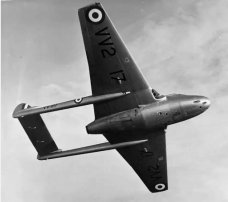
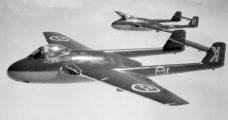
On the other hand, the object seen from the ground by the two women resembles a "Vampire" so closely that I do not see how this explanation could be ruled out:
|
|
|

|
|
The first De Havilland DH100 "Vampire" aircraft were delivered to the Swedish Air Force in March 1946.
Possible extraterrestrial visitors.
* = Source is available to me.
? = Source I am told about but could not get so far. Help needed.
| Main author: | Patrick Gross |
|---|---|
| Contributors: | None |
| Reviewers: | None |
| Editor: | Patrick Gross |
| Version: | Create/changed by: | Date: | Description: |
|---|---|---|---|
| 0.1 | Patrick Gross | May 20, 2026 | Creation, [int1], [dbr1], [gjn1], [dwn1], [gvo1], [afu1], [snu1], [mss1], [tgd1], [nip1], [get1], [jmd1], [csn1]. |
| 1.0 | Patrick Gross | May 20, 2026 | First published. |
| 1.1 | Patrick Gross | June 28, 2026 | Addition [dbr2]. |