Cherbourg, France, on January 18, 1946:
ACUFO-1946-01-18-CHERBOURG-1
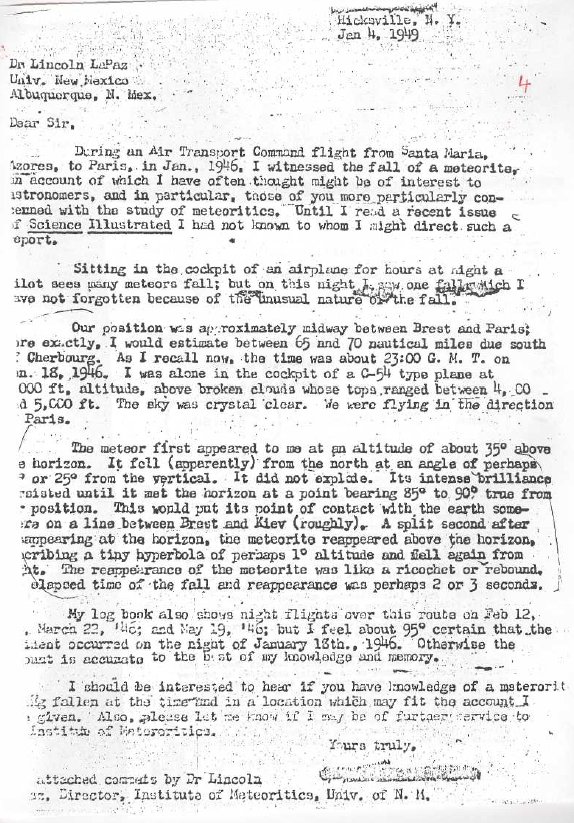
A non-anonymous pilot letter to Dr. Lincoln LaPaz, University of New Mexico, written on January 4, 1949, was found in the archive of the US Air Force "Project Blue Book" UFO project by US ufologist Jan Aldrich, who told about it in his 2000 monograph "The Ghost Rocket File".
In his letter, the pilot, whose name had been censored, explained that during an Air transport Command flight from Santa Maria, Acores, to Paris, in Jan. 1946, he saw the fall of a meteorite. The pilot, having read a recent article by meteors specialist Lincoln LaPaz in Science Illustrated, thought the latter may be interested in his report.
The pilot explained that sitting in the cockpit of an airplane for hours at night, a pilot sees many meteor fall; but on this night he saw one falling which he did not forget because of the unusual nature of the fall.
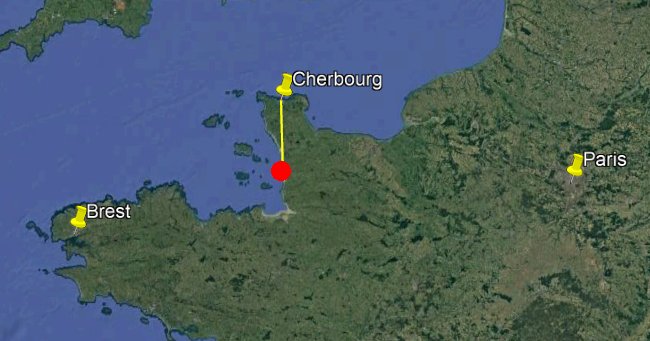
His plane, he said, was approximately midway between Brest and Paris or more exactly, he estimated, between 65 and 70 nautical miles due south of Cherbourg flying in the direction of Paris.
As he now recalled, the time was about 23:00 G.M.T. and the date January 18, 1946. He was alone in the cockpit of a C-54 type plane at 7,000 ft. altitude, above broken clouds whose tops ranged between 4,000 - 5,000 ft. The sky was crystal clear.
The meteor first appeared to him at an altitude of about 35° above the horizon. It fell, apparently, from the north at an angle of perhaps 20° or 25° from the vertical. It did not explode. Its intense brilliance persisted until it met the horizon at a point bearing 85° to 90° true from the plane's position; which would put its point of contact with the earth somewhere on a line between Brest and Kiev roughly.
A split second after appearing on the horizon, the meteor reappeared above the horizon, describing a tiny hyperbola of perhaps 1° altitude, then it fell again from []ht. The reappearance of the meteorite was like a ricochet or rebound, elapsed time of the fall and reappearance was perhaps 2 ot 3 seconds.
The pilot explained that his log book also showed night flights over this route on February 12, March 22, and May 19, 1946; but he felt about 95° certain that the event occurred on the night of January 16, 1946.
The Air Force archive show that LaPaz subsequently wrote a letter to Dr. H. H. Landsberg, on January 12, 1949.
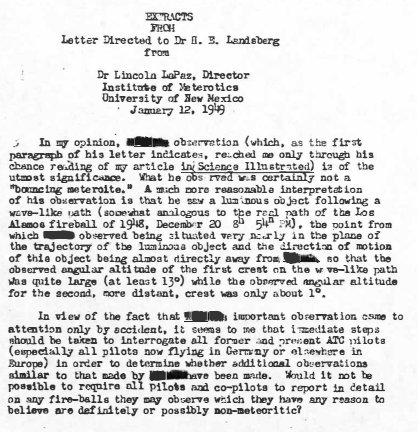
LaPaz said that in his opinion, the observation was of the utmost significance, that what the pilot observed was certainly not a "bouncing meteorite", that a much more reasonable interpretation of his observation is that he saw a luminous object following a wave-like path somewhat analogous to the real path of the Los Alamos fireball of 1948, December 20, 1949 at 8:54 p.m.
LaPaz said the point from which the pilot observed it was situated very neatly in the plane of the trajectory of the luminous object and the direction of motion of the object was almost directly away from the pilot so that the observed angular altitude of the first crest on the wave-like path was quite large - at least 13° - while the observed angular altitude for the second, more distant, crest was only about 1°.
| Date: | January 18, 1946 |
|---|---|
| Time: | 11:00 p.m. UTC |
| Duration: | Seconds. |
| First known report date: | January 4, 1949 |
| Reporting delay: | 3 years. |
| Country: | France |
|---|---|
| State/Department: | Manche |
| City or place: | Between 65 and 70 nautical miles due south of Cherbourg. |
| Number of alleged witnesses: | 1 |
|---|---|
| Number of known witnesses: | 1 |
| Number of named witnesses: | 1 |
| Reporting channel: | Letter to meteor export Lincoln La Paz. |
|---|---|
| Visibility conditions: | Night. |
| UFO observed: | Yes. |
| UFO arrival observed: | ? |
| UFO departure observed: | Yes. |
| UFO action: | Fall with rebound. |
| Witnesses action: | Observed. |
| Photographs: | No. |
| Sketch(s) by witness(es): | No. |
| Sketch(es) approved by witness(es): | No. |
| Witness(es) feelings: | Puzzled. |
| Witnesses interpretation: | Unusual bouncing meteor. |
| Sensors: |
[X] Visual: 1.
[ ] Airborne radar: N/A. [ ] Directional ground radar: N/A. [ ] Height finder ground radar: N/A. [ ] Photo: [ ] Film/video: [ ] EM Effects: [ ] Failures: [ ] Damages: |
|---|---|
| Hynek: | NL |
| Armed / unarmed: | Unarmed. |
| Reliability 1-3: | 3 |
| Strangeness 1-3: | 2 |
| ACUFO: | Unidentified. |
[Ref. bbk1:] LINCOLN LA PAZ - PROJECT BLUE BOOK ARCHIVE:
|
[Name blacked out]
Hicksville, N. Y.
Jan 4, 1949
Dr Lincoln LaPaz
Univ. New Mexico
Albuquerque, N. Mex.
Dear Sir,
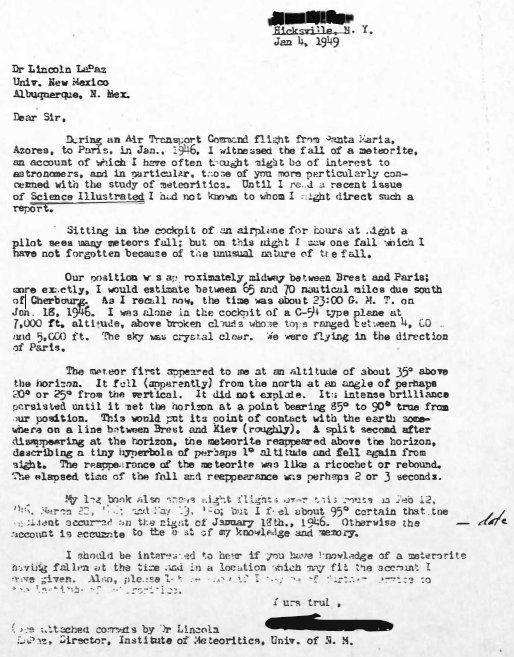
During an Air transport Command flight from Santa Maria, Acores, to Paris, in Jan. 1946, I witnessed the fall of a meteorite, an account of which i have often thought might be of interest to astronomers, and in particular, those of you particularly concerned with the study or meteorites. Until I read a recent issue of Science Illustrated I had not known to whom I might direct such a report.
Sitting in the cockpit of an airplane for hours at night a pilot sees many meteor fall; but on this night I saw one falling which I have not forgotten because of the unusual nature of the fall.
Our position was approximately midway between Brest and Paris; more exactly, I would estimate between 65 and 70 nautical miles due south of Cherbourg. As I recall now, the time was about 23:00 G.M.T. on Jan. 18, 1946. I was alone in the cockpit of a C-54 type plane at 7,000 ft. altitude, above broken clouds whose tops ranged between 4,000 - 5,000 ft. The sky was crystal clear. We were flying in the direction Paris.
The meteor first appeared to me at an altitude of about 35° above the horizon. It fell /apparently) from the north at an angle of perhaps 20° or 25° from the vertical. It did not explode. Its intense brilliance persisted until it met the horizon at a point bearing 85° to 90° true from my position. This would put its point of contact with the earth somewhere on a line between Brest and Kiev (roughly). A split second after appearing on the horizon, the meteorite reappeared above the horizon, describing a tiny hyperbola of perhaps 1° altitude and fell again from []ht. The reappearance of the meteorite was like a ricochet or rebound, elapsed time of the fall and reappearance was perhaps 2 ot 3 seconds.
My log book also shows night flights over this route on Feb. 12, March 22, and May 19,1946; but I feel about 95° certain that the event occurred on the night of January 16th, 1946. Otherwise the account is accurate to the best of my knowledge and memory.
I should be interested to hear if you have knowledge of a meteorite fallen at the time and in a location which may fit the account I have given. Also, please let me know if I may be of further service to the Institute of Meteoritics.
Yours truly.
[Name blacked out]
attached comments by Dr Lincoln LaPaz, Director, Institute of Meteoritics, Univ. of N. M.
Different copy of the document:
|
[Ref. llz1:] DR. LINCOLN LAPAZ:
|
EXTRACTS
FROM
Letter Directed to Dr H. H. Landsberg
from
Dr Lincoln LaPaz, Director
Institute of Meterotics
University of New Mexico
January 12, 1949
In my opinion, [-] observation (which, as the first paragraph of his letter indicates, reached me only though his chance reading of my article in Science illustrated) is of the utmost significance. What he observed was certainly not a "bouncing meteorite." A much more reasonable interpretation of his observation is that he saw a luminous object following a wave-like path (somewhat analogous to the real path of the Los Alamos fireball of 1948, December 20 8:54 PM), the point from which [-] observed being situated very neatly in the plane of the trajectory of the luminous object and the direction of motion of this object being almost directly away from [-] so that the observed angular altitude of the first crest on the wave-like path was quite large (at least 13°) while the observed angular altitude for the second, more distant, crest was only about 1°.
In view of the fact that [-] important observation came to attention only by accident, it seems to me that immediate steps should be taken to interrogate all former and present ATC pilots (especially all pilots now flying in Germany or elsewhere in Europe) in order to determine whether additional observations similar to that made by [-] have been made. Would it not be possible to require all Pilots and co-pilots to report in detail on any fire-balls they may observe which they have any reason to believe are definitely or possibly non-meteoritic?
[Ref. llz2:] DR. LINCOLN LAPAZ:
[LaPaz:] I published not long ago an article in Science Illustrated on the recovery of the [-] Town meteorite. The time that fall, February 18, 1948, the rumor got around somehow in Northern Kansas and Southern Kansas that it was a Russian bomb, and it was aimed at the geographical center of the United States which is not very far from [-]. Apparently, a great many people gave credence to that rumor and were delighted when we finally recovered meteorites up there and proved it wasn't anything but an ordinary meteorite fall. Incidentally, it did not have the characteristics of the green fireball we're talking about here. There was an air transport pilot who made a most curious observation while flying near Cherbourg on January 16, 1946. His observation was the observation of a bouncing meteor. After what I've been telling you about the green fireballs, you probably think it not unreasonable that a meteorite should bounce but to the meteorlytical mind that seems very hard to swallow. The interest is that one of your own persons here at Los Alamos, one and confirmed at least in part by four other persons, saw one of the green fireballs come down and then glide off horizontally. The bouncing meteorite is manually explained by having it form, say sinusoidal motion lying in about the plane at which the observer was looking so that he first saw the high point of the curve or the peak. The next time it was at the peak, it was so far away that the altitude was very low, which will give you the appearance of a bouncing meteorite. I offer that as a possible explanation. Of course, he may have landed in Paris before he made the Cherbourg flight and then we should disregard the testimony entirely!
[Ref. lgs1:] LOREN E. GROSS:
|
An American C-54 transport plane was 7,000 feet over the French countryside on its way to Paris. Some 3,000 feet below the plane was a layer of broken clouds, but above that the sky was clear. It was 11 o'clock at night on January 18, 1946. The flight was uneventful until suddenly the pilot of the C-54 saw a brilliant "shooting star" appear 35 degrees above the horizon. The "shooting star" streaked downward without exploding. The brilliant blob dropped below the eastern horizon, but then, much to the pilot's surprise, the "shooting star" quickly reappeared! The "shooting star" came back into view and: "... described a tiny hyperbola of perhaps of one degree altitude and fell again from sight." 1. Those were the words of the pilot who felt that the "shooting star" did the impossible by ricocheting or rebounding. This event marked the beginning of numerous sightings of strange phenomenon in the skies of Europe.
The source "1." is detailed as:

|
1. Letter: To: Dr. Lincoln La Paz, University of New Mexico, Albuquerque. From: -- (deleted) Hicksville, New York. 4 January 49. Air Force Blue Book Files.
[Ref. dwn1:] DOMINIQUE WEINSTEIN:
French ufologist Dominique Weinstein compiled a catalog of the cases of UFOs observed from aircraft ([dwn1]). The first case in February 2001 (6th edition) catalog appears as:

|
| DATE | 45.01.18 |
|---|---|
| TIME | 23.0: |
| COUNTRY | France |
| PLACE | near Cherbourg |
| M | |
| TYPE OF PLANE AND WITNESSES | a US C-54 pilot |
| DESCRIPTION OVNI | a bright "shooting star" streaked downward without exploding then came back |
| Radar | |
| G | |
| X | |
| E | |
| SOURCES | 404 / 400 03 |
The source "404" is referenced at the end of the catalog as:
UFOs a history: 1946 the ghost rockets, Loren Gross
The source "400" is referenced at the end of the catalog as:
*U* UFO Data base and research tool, Larry Hatch, 142 Jeter street, Redwood City, CA 94062-1957, USA
The source "03" is referenced at the end of the catalog as:
Project 1947 Reports, newsclippings and documents (cases from Jan Aldrich and Barry Greenwood)
[Ref. lhh1:] LARRY HATCH:
560: 1946/01/16 23:00 1 1:37:00 W 49:38:00 N 3333 WEU FRN MNC 5:7
nr CHERBOURG,FR:AF C54 XPORT PILOT:ODD METEOR ^:REBOUNDS ^ +DESCENDS AGAIN.
Ref#133 GROSS,L.:UFOs a HISTORY-1949 4 books Book # 1 Page 32: IN-FLIGHT
[Ref. gvo1:] GODELIEVE VAN OVERMEIRE:
|
1946, January 18
France, Cherbourg
The pilot of a C47 saw at 11 p.m. a bright "shooting star" descend without exploding and then rise again. (PROJECT ACUFOE, Catalogue 1999, Dominique Weinstein)
[Ref. cus1:] "CENTER FOR UFO STUDIES" WEBSITE:
At 11:00 p.m. on January 18, 1946, as an American C-54 transport plane was passing over rural France at 7,000 feet, the pilot observed what he took to be a brilliant meteor at 35° above the eastern horizon. The object fell and was lost to view - but only momentarily. To the witness' astonishment, the "meteor" ascended, then "described a tiny hyperbola of perhaps one degree altitude and then fell again from sight." Whatever the phenomenon was, it clearly had not been a meteor. Soon Europeans and others would call such phenomena "ghost rockets" and ascribe them to secret Soviet experiments with captured German V-2 missiles. Many of the "rockets" would be meteors, but none, so history attests, were missiles from Russia, which then possessed only a primitive missile technology.
[Ref. tai1:] "THINK ABOUT IT" WEBSITE:
Date: January 18, 1946
Location: Cherbourg, Basse-Normandie, France
Time: 23:00
Summary: USAAF C-54 Pilot incident. Bright "shooting star" streaked downward without exploding, then came back. An unidentified object was sighted, that had an unusual appearance or performance. One light was observed by one experienced male military witness in a warplane.
Source: Weinstein, Dominique Aircraft UFO Encounters Project ACUFOE, Paris, 1999
|
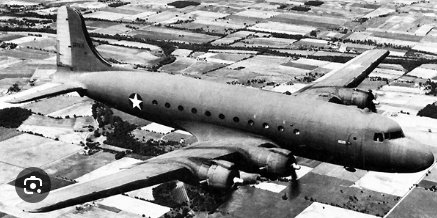
The C-54 (photo above) was the military version of the Douglas DC-4 "Skymaster", an unpressurized four-engine transport aircraft capable of carrying 65 equipped soldiers or more than five tons of cargo over a distance of 4,000 km. It first flew in March 1942 and was built during the Second World War in more than 1,300 units.
|
The observation location would be at the red dot on the map above.
Lincoln LaPaz (1897-1985) was an American mathematician astronomer from the University of New Mexico and a pioneer in the study of meteors, directing the Universtity's Institute of Meteoritics.
LaPaz became involved in ufology because he had his own sighting with his family on July 10, 1947, only few days after the infamous "Roswell" incident and only 70 miles north of Roswell near Fort Sumner.
He became involved in military UFO investigations during the late 1940s and early 1950s, on the wave of "green fireballs" in New Mexico, from late 1948 and through the 1950s, and the search for near-Earth orbiting satellites in 1954 along with fellow N.M. astronomer Clyde Tombaugh.
The LaPaz article the pilot read was "Morton County Meteorite," in Science Illustrated, Vol. 3, pages 23-25, November 1948.
Helmut Erich Landsberg (1906-1985) was a noted and influential climatologist also working on meteorology and atmospheric science. He implemented statistical analysis in meteorology in aiding military operations during World War II. In 1946, he was the acting director of the Joint Research and Development Board's Committee on Geophysical Sciences and he became the director of the board in 1949.
For a meteor to bounce off Earth's atmosphere, it has to enter the atmosphere at a fairly shallow angle. In this case, like a rock skipping off a lake, the meteor briefly enters the atmosphere before exiting again.
I found no record that a bouncing meteor was ever observed bouncing off the atmosphere then entering the atmosphere again.
In this case, the pilot said the object arrived at "an angle of perhaps 20° or 25° from the vertical"; even if it was very far and perspective played a role, this does not seem to well allow the "bouncing meteor" explanation, given the initial height of 35° avove the horizon.
Unidentified.
* = Source is available to me.
? = Source I am told about but could not get so far. Help needed.
| Main author: | Patrick Gross |
|---|---|
| Contributors: | None |
| Reviewers: | None |
| Editor: | Patrick Gross |
| Version: | Create/changed by: | Date: | Description: |
|---|---|---|---|
| 0.1 | Patrick Gross | June 25, 2026 | Creation, [bbk1], [llz1], [llz1], [lgs1], [dwn1], [lhh1], [gvo1], [cus1], [tai1]. |
| 1.0 | Patrick Gross | June 25, 2026 | First published. |